French label releasing records of sound-art, electroacoustic, experimental, no matter the name music.
Sign in
Login
Register

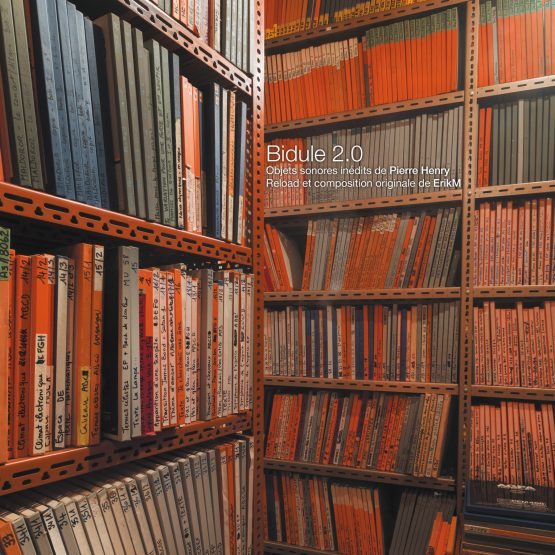
ErikM – “Bidule 2.0”
22,00 €
Unreleased Sound Objects by Pierre Henry / Reload and Original Composition by ErikM
Bidule 2.0 is an unique reinterpretation of Pierre Henry's little-known sound heritage combined with ErikM's original composition. The album explores previously unused raw materials, transformed through ErikM's highly digital approach, balancing fixed composition and unexpected sonic events, a singular sonic experience where where historical archives and contemporary creation converge.
« Bidule 2.0 is a composition by ErikM that revisits a selection of the unused sonic heritage of composer Pierre Henry, covering the period from 1950 to 1974, sourced from the Son/Ré studio and digitized by the BnF (Bibliothèque nationale de France).
Over the decades, Pierre Henry and his team accumulated a vast collection of sonic materials from their studio research.This sound library, recorded on analog tape, is a testimony to the recording techniques of that era — including the quality of microphones and recording media, as well as the acoustics of the recording spaces — all of which define the sound of a time.
Not wanting to create a remix from the composer’s iconic sounds, I chose instead to work with selections of raw material from unused recording sessions, 168 sequences ranging from one to twenty-two minutes each. Isabelle Warnier and Bernadette Mangin provided me with sessions of prepared piano, series of electronic sounds, feedbacks, and voice recordings.
Pierre Henry’s analog sounds were, for the most part, processed through successive stages (up to five generations of transformation), using a custom electronic device: Idiosyncrasie 9.3, built on Max/MSP and Lemur. »
ErikM
Production : CNCM/La Muse en Circuit, Alfortville et INA/GRM Paris
Coproduction : CNCM/GMEM, Marseille
Mastering : Frédéric Alstadt – Angstrom Mastering
A live performance at Présences électronique festival is included on CD version as bonus track.
Add to cart
P16.D4 – “Distruct”
20,00 €
Distruct
Directed by P16.D4
Assemblage of transformed, organized and (re)structed sound material submitted by:
Bladder Flask, Déficit Des Années Antérieures, De Fabriek, The Haters, Philip Johnson, Hiroki Kocha, Merzbow, Fredrik Nilsen, Nocturnal Emissions, Nurse With Wound, Onnyk, Harold Schellinx, Die Tödliche Doris, Vortex Campaign.
"On this, their second LP, P16.D4 solicited tapes from several artists from Europe, England, the U.S., Canada, and Japan, and mixed that with their own material. Though in the current digital age collaborations from artists thousands of miles apart is quite normal, this was a quite radical approach back in 1982, when work on this LP began – an interesting concept that actually works quite well, since these artists, which include Bladder Flask, DDAA, the Haters, Merzbow, Nocturnal Emissions, Nurse With Wound, and several others – work in a similar free-ranging experimentalism as P16.D4, and their particular elements, usually just vocals or one instrument or noise implement, blend well without diluting P16.D4’s own peculiar brand of avant-garde post-industrialism, but merely give it another facet. One of the best tracks, “Aufmarsch, Heimlich,” consists of a choir submitted anonymously from Eastern Europe phasing in and out of static while a skronky alto sax bleats away. Most of the pieces exist somewhere just beyond the borders of free jazz, industrial, and even classical avant-garde, full of jarring noises and strange transitions and with a heavy overlay of electronics. What started out as an experiment yielded one of P16.D4’s best albums."
Rolf Semprebon / AMG
"Distruct is organized around sounds provided by the cream of experimental musicians of the early '80s, from Nurse With Wound to Nocturnal Emissions, via De Fabriek, Die Todliche Doris, The Haters, Merzbow, and others. Obviously, there is no question of remixing here, and at no time do P16.D4 seek to hide its sources, clearly identifying the contribution of each artist in the liner notes. It would be futile to try to find the paw of each artist, the trio operating vis-à-vis its collaborators the same methods as in their own work. Reworked, distorted by various effects, cut, edited, aggregated with other sounds, produced by P16.D4 themselves, reprocessed. Exchange, communication, two other data that will constantly recur in the work of P16.D4, rich in external contributions and encounters of all kinds. Musically, and despite the diversity of sources treated, Distruct escapes the heterogeneous character, which often marks this type of collaboration, to offer a coherent whole: fragments of opera, Soviet speeches, out-of-tune guitar, saxophone, tattered violins, overdriven and metallic noisy attacks, jackhammers, field recordings, battered choirs, and many other less identifiable sounds. In addition to the desired dialogue between the artists, Distruct also offers a real reflection on listening, and on the expectations of the listener."
Dissolve
P16.D4 was a German electronic noise music collective, active primarily from 1980 to 1988. P16.D4 embraced tape cut-ups, musique concrète, endless recycling and transformation of previously published material, and many long-distance collaborations with like-minded artists such as DDAA, Vortex Campaign, Nurse With Wound, and Merzbow. Their active participation in the international industrial tape scene yielded collaborative output such as their release Distruct, where bands such as Nurse with Wound, Nocturnal Emissions, Die Tödliche Doris, and The Haters provided the source material. The longest-term collaboration was with the installation and conceptual artist Achim Wollscheid, who used P16.D4 sounds as the basis for LPs he recorded under the name SBOTHI. Ralf Wehowsky, the only constant member of the group, later released solo material under the alias RLW. Members of P16.D4 were also involved with Selektion, a collective of people involved with sound as well as the visual arts. Selektion published LPs, CDs, books, visual art and design. The collective worked in a strongly improvised, spontaneous and anti-professional way, using acoustic and electronic instruments, using existing sound fragments, duplicating and alienating them, using repetition, distortion, changes in speed and playing direction. For this they used not only sounds of other artists but also their own material from earlier productions. Late works of the collective are associated with musique concrete.
Add to cart
P16.D4 was a German electronic noise music collective, active primarily from 1980 to 1988. P16.D4 embraced tape cut-ups, musique concrète, endless recycling and transformation of previously published material, and many long-distance collaborations with like-minded artists such as DDAA, Vortex Campaign, Nurse With Wound, and Merzbow. Their active participation in the international industrial tape scene yielded collaborative output such as their release Distruct, where bands such as Nurse with Wound, Nocturnal Emissions, Die Tödliche Doris, and The Haters provided the source material. The longest-term collaboration was with the installation and conceptual artist Achim Wollscheid, who used P16.D4 sounds as the basis for LPs he recorded under the name SBOTHI. Ralf Wehowsky, the only constant member of the group, later released solo material under the alias RLW. Members of P16.D4 were also involved with Selektion, a collective of people involved with sound as well as the visual arts. Selektion published LPs, CDs, books, visual art and design. The collective worked in a strongly improvised, spontaneous and anti-professional way, using acoustic and electronic instruments, using existing sound fragments, duplicating and alienating them, using repetition, distortion, changes in speed and playing direction. For this they used not only sounds of other artists but also their own material from earlier productions. Late works of the collective are associated with musique concrete.
P16.D4 – “Kühe in 1/2 trauer”
20,00 €
"This music is staggeringly original and innovative, and while it's possible to locate it in a chain of circumstance that links it to 'Industrial' music, P16.D4 indulged in none of the empty cliches associated with the genre, worked incredibly hard, and seem to have been aiming at a form of sound art that was much more profound, varied, subversive, and potentially dangerous. Kuhe In 1/2 Trauer's accompanying credits indicate their radical approach to making music: lots of improvisation, lots of live electronics, extensive use of tape-loops, some conventional instrumentation, and much that isn't – like the milk churn on 'Paris, Morgue' or the use of baking tray and washing machine elsewhere. Even when guitars, drums or keyboards are used, they're played very weirdly. It's not even made clear who was doing what; the main credit is 'Concept,' which I assume means that one of the three devised the framework in which the noise would operate itself, and while RLW gets the lion's share of these credits, a lot of the cuts are evenly divided among the team and I have no doubt that the group operated in a very democratic or libertarian manner. None of this prepares you for the insane and troubling sounds that reach your ears, composed with scant regard for conventional logic and following an exciting, absurdist path, especially in the matter of tape edits and juxtapositions of recordings."
Ed Pinsent, The Sound Projector.
"Though this German group started out as a the new wave band P.D., by the time of Kuhe in 1/2 Trauer, their first LP under the P16.D4 name from 1984, they had developed far beyond into extremely experimental music similar to other post-industrial artists working with abstract avant-garde soundscapes. There's a bleak industrial feel to the gritty, lo-fi electronics and tape loops, while the group throws in enough curve balls to keep it interesting. On some pieces, strange, looped choirs bubble out of throbbing pulses and drones of feedback, while others have clanging and clattering, and elements of musique concrète and improvisation blur the boundaries even further. The opening track, "Default Value," is one of those disorienting pieces with noises flying everywhere, while "Paris Morgue" takes excerpts from one of their old P.D. tracks and messes it up with additional instruments, while the ungainly titled fourth track throws in a heavy texture of percussive noises to create an edgy ambience about to teeter off the edge, and the even darker and more ambient title track takes the tension even further. Arrhythmic and amorphous and capable at moments of becoming quite noisy and abrasive, while at others far more somber and quiet, Kuhe in 1/2 Trauer is quite a fascinating release."
Rolf Semprebon / AMG
P16.D4 was a German electronic noise music collective, active primarily from 1980 to 1988. P16.D4 embraced tape cut-ups, musique concrète, endless recycling and transformation of previously published material, and many long-distance collaborations with like-minded artists such as DDAA, Vortex Campaign, Nurse With Wound, and Merzbow. Their active participation in the international industrial tape scene yielded collaborative output such as their release Distruct, where bands such as Nurse with Wound, Nocturnal Emissions, Die Tödliche Doris, and The Haters provided the source material. The longest-term collaboration was with the installation and conceptual artist Achim Wollscheid, who used P16.D4 sounds as the basis for LPs he recorded under the name SBOTHI. Ralf Wehowsky, the only constant member of the group, later released solo material under the alias RLW. Members of P16.D4 were also involved with Selektion, a collective of people involved with sound as well as the visual arts. Selektion published LPs, CDs, books, visual art and design. The collective worked in a strongly improvised, spontaneous and anti-professional way, using acoustic and electronic instruments, using existing sound fragments, duplicating and alienating them, using repetition, distortion, changes in speed and playing direction. For this they used not only sounds of other artists but also their own material from earlier productions. Late works of the collective are associated with musique concrete.
Add to cart
P16.D4 was a German electronic noise music collective, active primarily from 1980 to 1988. P16.D4 embraced tape cut-ups, musique concrète, endless recycling and transformation of previously published material, and many long-distance collaborations with like-minded artists such as DDAA, Vortex Campaign, Nurse With Wound, and Merzbow. Their active participation in the international industrial tape scene yielded collaborative output such as their release Distruct, where bands such as Nurse with Wound, Nocturnal Emissions, Die Tödliche Doris, and The Haters provided the source material. The longest-term collaboration was with the installation and conceptual artist Achim Wollscheid, who used P16.D4 sounds as the basis for LPs he recorded under the name SBOTHI. Ralf Wehowsky, the only constant member of the group, later released solo material under the alias RLW. Members of P16.D4 were also involved with Selektion, a collective of people involved with sound as well as the visual arts. Selektion published LPs, CDs, books, visual art and design. The collective worked in a strongly improvised, spontaneous and anti-professional way, using acoustic and electronic instruments, using existing sound fragments, duplicating and alienating them, using repetition, distortion, changes in speed and playing direction. For this they used not only sounds of other artists but also their own material from earlier productions. Late works of the collective are associated with musique concrete.
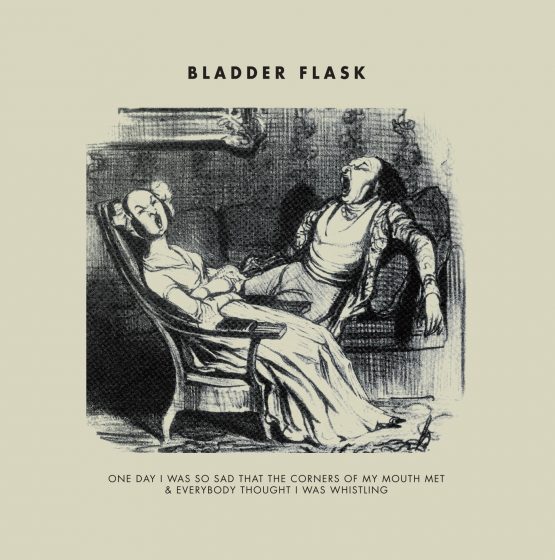
BLADDER FLASK – “One Day I Was So Sad …”
20,00 €
Bladder Flask
"One Day I Was So Sad That The Corners Of My Mouth Met & Everybody Thought I Was Whistling"
Bladder Flask's debut (in fact only) LP, originally issued by Orgel Fesper Music in 1981, is one of the most eclectic albums of the post-Industrial era. It is both challenging and perplexing... So, put down your puny instruments of normality and breathe in the frenzied fungal spores of Bladder Flask!
The fact that Steven Stapleton of Nurse With Wound is a big fan of this album is testament to its greatness:
'I love Bladder Flask's One Day I Was So Sad That The Corners Of My Mouth Met & Everybody Thought I Was Whistling and what a great title, perhaps my favourite ever. I must have listened to the album so much in the '80s. I listened to it again recently and it was like welcoming an old friend.'
Personnel: Richard Rupenus, Philip Rupenus + Sean Breadin, John Mylotte, Nigel Jacklin
Recorded at Wrongrong Studio and Spectro Arts Workshop 1980 – 1981
Audio Restoration & Mastering: Colin Potter @ IC Studio
LP tracklisting :
I: It Takes A Bliss
II: Musical Behind Head
A selection of comments & reviews: Very scrap merchant, very Dada... Comparisons could be made to NWW's Merzbild Schwet: a mixture of Musique Concrete and instrumental collages, but more intense and compact than NWW. An extremely interesting album and very cleverly done, especially the editing of complex tape treatments. Neumusik A puzzlingly great album. Ah, the halcyon days of bungled Kurt Weill renditions, overactive splicing hands and tape-loops lasting only a few seconds before being smudged by hyper fast-forwarding, like a random, operatic battle of thermopylae as re-created by members of NWW. Faced with omnipresent latter-day refined-aesthetic cognescenti, whose duty it is to remind one of the gravity of modern music, I find myself defending such gut-level joyous stupidity and its gung-ho determination to vertiginously swirl about all manner of daft sundries, with no regard for the mess that may be left afterwards. This is why I like this stuff and some of the worries of the world can be, if not alleviated, at least disguised in the scent of Bladder Flask's audio compost pot-pourri. Bananafish A masterpiece of unrestrained Dada music, Musique Concrete and Electro-Acoustic Improv. Primitive electronics meet the sounds, or rather shreds thereof, of various acoustic instruments, field recordings, found objects, mysterious devices as well as body slapping, whistles and smacks. An augury of what the radicals of Electro-Acoustic music do nowadays, but here you also get surreal humour that could safely rank alongside the best, wildest works of NWW. Activists One Day I Was So Sad... comprises two side-long tracks of extended Dadaist reverie, a sublime mix of Musique Concrete and instrumental collages. Bladder Flask and their ilk were spiritual forefathers to today's 'clicks and cuts' generation, creating a slapdash Industrial experimental music which exploited the idiosyncrasies of analogue tape assemblage and editing. I love this album to pieces and it gets my highest recommendation. Other Music This packs a helluva lot into its generous playing-time. The side-long 'It Takes A Bliss' ranges from free sounding structures of various instruments (played with relish) to a sometimes unnerving encounter with distorted piano strings, guitars and less identifyable sounds. The chemistry which prevents this from becoming self-indulgent is what makes Bladder Flask tick. They wind through an unsettling amount of images and the recording, mixing and editing must have taken a very long time. Most of the music is very spontaneous with even 'Goon' type voices appearing before being shredded by the next 'act.' It's like a successive queue of cameos all awaiting and clambering for your attention. Side two, 'Musical Behind Head,' has slightly more direction and cohesion (or perhaps I just began to adjust to the music?) I was rather stupefied by the contents of this strange menagerie of experimental dialogue. A unique album. Outlet Mind-boggling Fluxus, Dada, Improv, Sound Art and cut-up queasy lunacy. When the LP was originally issued in 1981 it left all those who heard it (including an awe struck Steven Stapleton) flat on their backs. Its two sides of collage combines spoken word samples, people shouting and going mad, hammered piano keys, strummed, out of tune guitars, honking saxophones, wheezy melodicas, sci-fi bloops, tape splurge, preset keyboard beats, train whistles, rattled cutlery drawers, clockwork toys, clanging steel pipes, records spinning at the wrong speed. A myriad of juxtaposed sounds and atmospheres of utter strangeness and beguiling entropy. A sound world that up until 1981 I doubt barely existed. An intriguing, delightful and, at times, unsettling experience. Idwal Fisher One Day I Was So Sad... is that ne plus ultra of cut-up sound art. It is an extremely strange - at times, quite hilarious - experiment in fast-moving cut-ups. Its sheer incoherence starts from the get-go and doesn't release its hold on your poor cerebellum until you too are dragged down to a state of lunatic frenzy. It's not a record you would play for fun, but its fractured consciousness, incoherence, and sheer Dadaist lunacy are considerable. God alone knows what sources were used to create it: screaming and coughing, all-manner of acoustic instruments are mauled and mutilated; a trumpet blown by a fat whaler, violins scraped by cretinous monkeys. Aiming for maximum disorientation, it challenges you to keep up with its restless and intense flow of ideas and you're challenged to see past the apparent silliness of it all. Sourced presumably from multiple found sounds, tapes, and records, the piece was assembled in a deliberately fragmented fashion, each sample lasting only a few seconds and bearing no connection whatever to the next. One of the striking aspects of this concoction is the odd and ill-fitting mix of vulgar, crass humour with moments of near-pathological darkness. It's like watching a slapstick movie from the 1930s spliced with a low-budget Italian zombie movie – custard pie fights morphing into monstrous flesh-eating, similar to how Dali and Bunuel claimed that they assembled the first Surrealist movie, Un Chien Andalou. You're pulled in both directions at once until you can hear your own sinews snapping. It's not a record you would play for fun, but its fractured consciousness, incoherence, and sheer Dadaist lunacy are considerable. It's as if Bladder Flask were possessed by some fevered desire to surpass the worst excesses of the lunatic fringe end of the United Dairies catalogue. But this LP had the underlying sinister aim of sending all those who heard it mad, through highlighting the complete absurdity and futility of everything. A gibbering masterpiece. The Sound Projector One Day I Was So Sad... comprises, for the most part, a series of short collages which are seemingly disparate and fragmented: humorous vocal exercises, detuned piano, excerpts from Pop music and Free Jazz, electronics, tape-loops, accelerated scrolling of tapes, excerpts from film dialogues, among a thousand other things that are more difficult to identify. The flirtation with Dadaism, in particular the humour, joyful absurdity and disparate elements, is obvious. Virtuosity doesn't seem to be of any concern to the 'musicians' and it seems rather inconceivable that Bladder Flask are themselves the performers of all that can be heard. Although apparently totally random, the structure, if it can be called that, is more complex than it first appears and this is in fact a very meticulous work which must have been extremely laborious considering all the tape-splicing and editing involved. Industrial Musics One Day I Was So Sad... is one of those records which could be described as abstract but it's much more than that with elements of Musique Concrete, Free Jazz and Free Improvisation although it doesn't sit comfortably in any particular genre. It has a total disregard for the constraints of Western music, be it song structure, tunes, harmony, scales, metrics, notations and other rules which are generally followed by musicians who pretentiously pose as experimental. To accurately describe this album would be very difficult, if not impossible. However, if you're looking for comparisons then I'd have to mention other records of an extreme, free-form nature such as The Faust Tapes or, maybe the most fitting of all, Frank Zappa's 'Nasal Retentive Calliope Music' which is one of the first and best examples of 'maniac' tape-manipulation. One Day I Was So Sad... is one of the most genuinely experimental (in the true sense of the word) records ever conceived and will appeal to those who like to push musical boundaries as far as possible. The fact that Steven Stapleton of NWW, who is considered by many to be a genius of experimentation and a living encyclopaedia of all things avant-garde, is a big fan of this album is proof of its greatness. One Day I Was So Sad... is a masterpiece of experimentation and a totally unclassifiable record. Debaser
Add to cart
A selection of comments & reviews: Very scrap merchant, very Dada... Comparisons could be made to NWW's Merzbild Schwet: a mixture of Musique Concrete and instrumental collages, but more intense and compact than NWW. An extremely interesting album and very cleverly done, especially the editing of complex tape treatments. Neumusik A puzzlingly great album. Ah, the halcyon days of bungled Kurt Weill renditions, overactive splicing hands and tape-loops lasting only a few seconds before being smudged by hyper fast-forwarding, like a random, operatic battle of thermopylae as re-created by members of NWW. Faced with omnipresent latter-day refined-aesthetic cognescenti, whose duty it is to remind one of the gravity of modern music, I find myself defending such gut-level joyous stupidity and its gung-ho determination to vertiginously swirl about all manner of daft sundries, with no regard for the mess that may be left afterwards. This is why I like this stuff and some of the worries of the world can be, if not alleviated, at least disguised in the scent of Bladder Flask's audio compost pot-pourri. Bananafish A masterpiece of unrestrained Dada music, Musique Concrete and Electro-Acoustic Improv. Primitive electronics meet the sounds, or rather shreds thereof, of various acoustic instruments, field recordings, found objects, mysterious devices as well as body slapping, whistles and smacks. An augury of what the radicals of Electro-Acoustic music do nowadays, but here you also get surreal humour that could safely rank alongside the best, wildest works of NWW. Activists One Day I Was So Sad... comprises two side-long tracks of extended Dadaist reverie, a sublime mix of Musique Concrete and instrumental collages. Bladder Flask and their ilk were spiritual forefathers to today's 'clicks and cuts' generation, creating a slapdash Industrial experimental music which exploited the idiosyncrasies of analogue tape assemblage and editing. I love this album to pieces and it gets my highest recommendation. Other Music This packs a helluva lot into its generous playing-time. The side-long 'It Takes A Bliss' ranges from free sounding structures of various instruments (played with relish) to a sometimes unnerving encounter with distorted piano strings, guitars and less identifyable sounds. The chemistry which prevents this from becoming self-indulgent is what makes Bladder Flask tick. They wind through an unsettling amount of images and the recording, mixing and editing must have taken a very long time. Most of the music is very spontaneous with even 'Goon' type voices appearing before being shredded by the next 'act.' It's like a successive queue of cameos all awaiting and clambering for your attention. Side two, 'Musical Behind Head,' has slightly more direction and cohesion (or perhaps I just began to adjust to the music?) I was rather stupefied by the contents of this strange menagerie of experimental dialogue. A unique album. Outlet Mind-boggling Fluxus, Dada, Improv, Sound Art and cut-up queasy lunacy. When the LP was originally issued in 1981 it left all those who heard it (including an awe struck Steven Stapleton) flat on their backs. Its two sides of collage combines spoken word samples, people shouting and going mad, hammered piano keys, strummed, out of tune guitars, honking saxophones, wheezy melodicas, sci-fi bloops, tape splurge, preset keyboard beats, train whistles, rattled cutlery drawers, clockwork toys, clanging steel pipes, records spinning at the wrong speed. A myriad of juxtaposed sounds and atmospheres of utter strangeness and beguiling entropy. A sound world that up until 1981 I doubt barely existed. An intriguing, delightful and, at times, unsettling experience. Idwal Fisher One Day I Was So Sad... is that ne plus ultra of cut-up sound art. It is an extremely strange - at times, quite hilarious - experiment in fast-moving cut-ups. Its sheer incoherence starts from the get-go and doesn't release its hold on your poor cerebellum until you too are dragged down to a state of lunatic frenzy. It's not a record you would play for fun, but its fractured consciousness, incoherence, and sheer Dadaist lunacy are considerable. God alone knows what sources were used to create it: screaming and coughing, all-manner of acoustic instruments are mauled and mutilated; a trumpet blown by a fat whaler, violins scraped by cretinous monkeys. Aiming for maximum disorientation, it challenges you to keep up with its restless and intense flow of ideas and you're challenged to see past the apparent silliness of it all. Sourced presumably from multiple found sounds, tapes, and records, the piece was assembled in a deliberately fragmented fashion, each sample lasting only a few seconds and bearing no connection whatever to the next. One of the striking aspects of this concoction is the odd and ill-fitting mix of vulgar, crass humour with moments of near-pathological darkness. It's like watching a slapstick movie from the 1930s spliced with a low-budget Italian zombie movie – custard pie fights morphing into monstrous flesh-eating, similar to how Dali and Bunuel claimed that they assembled the first Surrealist movie, Un Chien Andalou. You're pulled in both directions at once until you can hear your own sinews snapping. It's not a record you would play for fun, but its fractured consciousness, incoherence, and sheer Dadaist lunacy are considerable. It's as if Bladder Flask were possessed by some fevered desire to surpass the worst excesses of the lunatic fringe end of the United Dairies catalogue. But this LP had the underlying sinister aim of sending all those who heard it mad, through highlighting the complete absurdity and futility of everything. A gibbering masterpiece. The Sound Projector One Day I Was So Sad... comprises, for the most part, a series of short collages which are seemingly disparate and fragmented: humorous vocal exercises, detuned piano, excerpts from Pop music and Free Jazz, electronics, tape-loops, accelerated scrolling of tapes, excerpts from film dialogues, among a thousand other things that are more difficult to identify. The flirtation with Dadaism, in particular the humour, joyful absurdity and disparate elements, is obvious. Virtuosity doesn't seem to be of any concern to the 'musicians' and it seems rather inconceivable that Bladder Flask are themselves the performers of all that can be heard. Although apparently totally random, the structure, if it can be called that, is more complex than it first appears and this is in fact a very meticulous work which must have been extremely laborious considering all the tape-splicing and editing involved. Industrial Musics One Day I Was So Sad... is one of those records which could be described as abstract but it's much more than that with elements of Musique Concrete, Free Jazz and Free Improvisation although it doesn't sit comfortably in any particular genre. It has a total disregard for the constraints of Western music, be it song structure, tunes, harmony, scales, metrics, notations and other rules which are generally followed by musicians who pretentiously pose as experimental. To accurately describe this album would be very difficult, if not impossible. However, if you're looking for comparisons then I'd have to mention other records of an extreme, free-form nature such as The Faust Tapes or, maybe the most fitting of all, Frank Zappa's 'Nasal Retentive Calliope Music' which is one of the first and best examples of 'maniac' tape-manipulation. One Day I Was So Sad... is one of the most genuinely experimental (in the true sense of the word) records ever conceived and will appeal to those who like to push musical boundaries as far as possible. The fact that Steven Stapleton of NWW, who is considered by many to be a genius of experimentation and a living encyclopaedia of all things avant-garde, is a big fan of this album is proof of its greatness. One Day I Was So Sad... is a masterpiece of experimentation and a totally unclassifiable record. Debaser
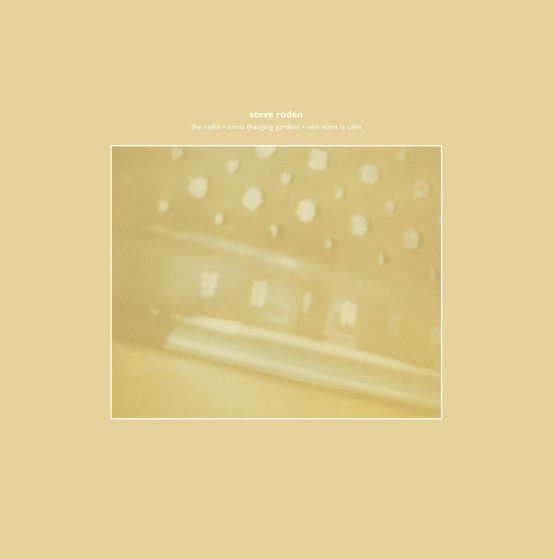
Steve RODEN – “the radio • airria (hanging garden) • vein stem is calm”
18,00 €
Sonoris is pleased to announce the release both on vinyl and cd, with a new mastering by Giuseppe Ielasi, of some important works from the influential and respected artist Steve Roden. These tracks, which mix conceptual composition and musicality, transcend the ambient or lowercase categories too quickly applied to his music, due to its ghostly beauty.
_
In the tradition of John Cage's Cartridge music amplified objects, Steve Roden extracts a fine and delicate music through his manipulation of specific objects, with an apparent simplicity that hides a captivating magic. Whilst reinventing a form of ambient music which is discreet and atmospheric, Steve Roden delivers sound textures, gives shape to color swatches, traces vibrant frequencies and creates visual art objects.
Roden, both a visual and a sound artist often tagged as minimal for want of a better description, builds the sound design of a life, a new construction for the future which encompasses architecture, visual arts, and painting in a single form.
• The radio (1996): The sound sources are derived from the object itself: the airwaves as well as the internal mechanics (aerial,springs, knobs ...). Originally released as a miniCD by Sonoris, this work centered on Roden's voice and found sound loops is now unexpectedly considered a classic and was seen as "a particularly modest form of genius" in a review by The Wire at the time.
• Airria ( hanging garden ) (2003): Arnold Schönberg's work " The book of hanging gardens " haunts the piece, and is used as a backbone over which a ghostly and exhilarating vocal hovers. Both unsettling and relaxing, this track from the "Speak no more about the leaves" CD has strangely become a mini phenomenon on youtube with its number of views and comments.
• Vein stem is calm (1996): A few seconds taken from a Ralf Wehowsky piece are shaped into a nocturnal raga imbued with substances of an indeterminate nature.
_
Steve Roden is a visual and sound artist from Los Angeles, living in Pasadena. His work includes painting, drawing, sculpture, film/video, sound installation, text and performance. In the sound works, singular source materials such as objects, architectural spaces, and field recordings, are abstracted through humble electronic processes to create new audio spaces, or possible landscapes. The sound works present themselves with an aesthetic Roden has described as lower case – sound concerned with subtlety and the quiet activity of listening.
_
Mastering by Giuseppe Ielasi.
Cut by Fred Alstadt at Studio Angström
Add to cart
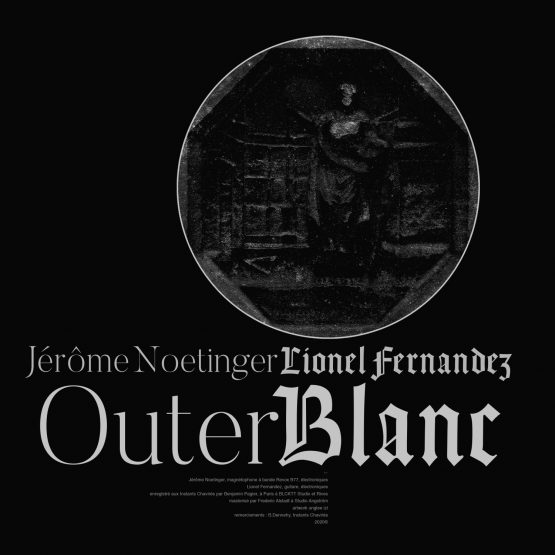
Jérôme NOETINGER & Lionel FERNANDEZ – “Outer Blanc”
18,00 €
Highly electrified guitar, anamorphosed, perforated, and tainted by all sorts of effects, implodes its rage and its urgency in the magnetic nets of a tape recorder as cannibal as it is destructive. From various recordings Lionel Fernandez & Jérôme Noetinger have created and produced these ten pieces: big, biting, dangerous and acerbic - like the intoxicated meeting of a chainsaw and a microphone. Real garage music: grease, gutted car bodies and outdated alternators, like a soundtrack ripped from an unreleased Tobe Hooper film.
Lionel Fernandez and Jérôme Noetinger: a musical encounter between two important and uncompromising figures in contemporary experimental music in France. This duo emerged during an evening of the label Premier Sang programmed at Instants Chavirés (Montreuil) in the 2010s... A few years and a few furious concerts later and it is now on the Sonoris label that they are releasing their first record.
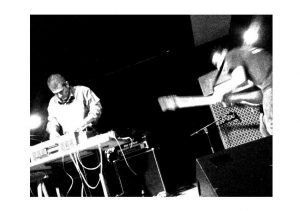 Guitarist of the pioneering french free noise/no wave band Sister Iodine, Lionel Fernandez uses an out of norm practice of the electric guitar in a group or as solo playing, "a guitar used as a flame thrower thrashed and fiercely held up as machette totem, he chops through darkness with unsane anti-riffs and carved blocs of dirty sounds, where gargle in slow combustion gangreened micro-textures » (Le Non_Jazz)
He also plays in other deviant combos such as Antilles, Cobra Matal, Ibiza Death, Haine, Porsche, Discom, Minitel, Mauser M etc and has collaborated either live or on records with Masaya Nakahara, Meyna’ch/Mütiilation, Andy Bolus/Evil Moisture, Stephen Bessac/Kickback, Hendrik Hegray, Tujiko Noriko etc..
Jérôme Noetinger is a composer, improviser and sound artist who works with electroacoustic devices such as the Revox B77 reel-to-reel tape recorder and magnetic tape, analogue synthesisers, mixing desks, speakers, microphones, various electronic household/everyday objects and home-made electronica.
From 1987 to 2018, he was the director of Metamkine, a non-profit organisation dedicated to the distribution of improvised and electroacoustic music. Between 1987 and 2014 Jérôme was a member of the editorial committee of the quarterly journal of contemporary sound, poetry and performance, Revue & Corrigée. For ten years from 1989, he was a member and programming co-ordinator of exhibitions, gigs, and experimental cinema at le 102 rue d'Alembert, Grenoble.
_
Lionel Fernandez, guitar, electronics
Jérôme Noetinger, Revox B77, electronics
10 tracks, 42 minutes, master by Fred Alstadt at Studio Angström
Guitarist of the pioneering french free noise/no wave band Sister Iodine, Lionel Fernandez uses an out of norm practice of the electric guitar in a group or as solo playing, "a guitar used as a flame thrower thrashed and fiercely held up as machette totem, he chops through darkness with unsane anti-riffs and carved blocs of dirty sounds, where gargle in slow combustion gangreened micro-textures » (Le Non_Jazz)
He also plays in other deviant combos such as Antilles, Cobra Matal, Ibiza Death, Haine, Porsche, Discom, Minitel, Mauser M etc and has collaborated either live or on records with Masaya Nakahara, Meyna’ch/Mütiilation, Andy Bolus/Evil Moisture, Stephen Bessac/Kickback, Hendrik Hegray, Tujiko Noriko etc..
Jérôme Noetinger is a composer, improviser and sound artist who works with electroacoustic devices such as the Revox B77 reel-to-reel tape recorder and magnetic tape, analogue synthesisers, mixing desks, speakers, microphones, various electronic household/everyday objects and home-made electronica.
From 1987 to 2018, he was the director of Metamkine, a non-profit organisation dedicated to the distribution of improvised and electroacoustic music. Between 1987 and 2014 Jérôme was a member of the editorial committee of the quarterly journal of contemporary sound, poetry and performance, Revue & Corrigée. For ten years from 1989, he was a member and programming co-ordinator of exhibitions, gigs, and experimental cinema at le 102 rue d'Alembert, Grenoble.
_
Lionel Fernandez, guitar, electronics
Jérôme Noetinger, Revox B77, electronics
10 tracks, 42 minutes, master by Fred Alstadt at Studio Angström
Add to cart
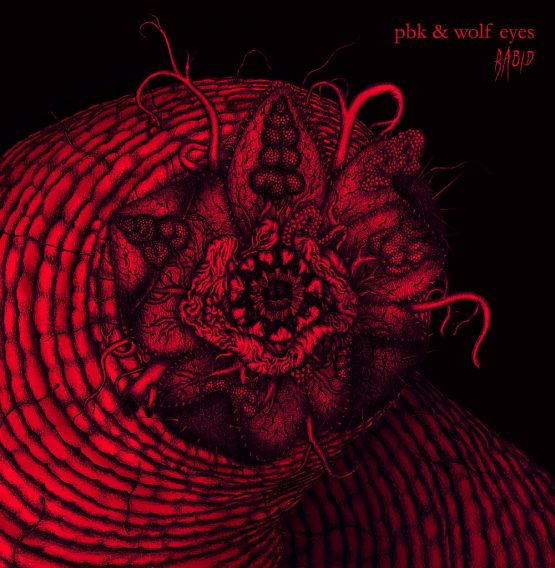
PBK & WOLF EYES – “Rabid”
15,00 €
“Rabid” consists of six tracks mixed by Phillip B. Klingler, aka PBK, between 2004-06 using Wolf Eyes source material, this is the Wolf Eyes lineup of 2000-05: Nate Young, John Olson and Aaron Dilloway.
Klingler: “I was given the audio sources (via cdr) by John Olson at the Ear Candy Festival in Dearborn, Michigan, in 2004. None of the compositions on the album were completed using a computer, they were all recorded live in my home studio or at gigs and radio shows directly to digital."
Three of the pieces on the LP were previously released in Russia on the CD, “Under My Breath”, in 2009. Also in 2009, the American Tapes label run by John Olson released a cdr of the PBK & Wolf Eyes collaborative tracks as part of the ongoing "Live Frying" series. Later, "Rabid" was available for a brief time as a net release. One review from the time stated: “Not a single track passes by without conveying grisly and creepy sensations of imminent death or disaster.”
Mastered for vinyl by Giuseppe Ielasi and with the beautiful cover illustration created by Pole Ka.
▪ American composer, Phillip B. Klingler, better known as PBK, has been active in the experimental music underground since 1986. His compositions are created using extreme turntable manipulation, sampling, analog and digital synthesis. Improvising spontaneously and with little preconception, PBK creates pulsing, dense soundscapes of unknown sonic origin. [wikipedia]
▪ Wolf Eyes is a post-industrial/noise band from Detroit, Michigan. They are widely considered the "kings of US noise".
"Their development since the earliest rumblings in 1997 has yielded some of the most staggering and genre-defining sounds of noise and sound art's dense, largely obscured history." (Allmusic)
Add to cart
eRikm – “L’art de la fuite”
15,00 €
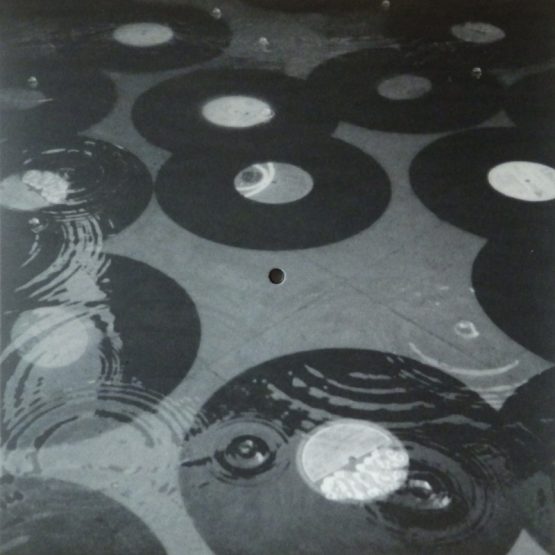
L'art de la fuite is a selection of first recordings originally released on selftitled homemade tape in 1995. Mainly composed with turntables and prepared records (with various other sources), these recordings have laid the foundation for his future work as turntabilist / improviser / composer. 20 years later, this unique blend of musique concrète and post-industrial still sounds fresh today.
Mastered by Giuseppe Ielasi.
«Over the years there have been reviews of the work of eRikm, as he likes to spell out his name, sometimes solo, but by my own estimation more in collaboration with other people. His main instruments are media products, such as vinyl and CDs, which he damages and then starts playing again, layering them together into new compositions. He has been doing so for more than twenty years. In 1995 he released his fourth cassette, in which he worked with vinyl more than CDs, using, if the postcards are any help, three turntables at the time, scratching records, carving grooves to create loops, cutting records in half and sticking them back together, making burn holes and such like. It's not unlike the work of Milan Knizak, who coined the term 'broken music' already in the sixties and Christian Marclay. eRikm put this on a four-track cassette and created his own compositions with these sounds, and I must say I quite enjoyed this lot. If I'm honest I find the whole turntablist movement a bit tiring, but what eRikm does here is very good. His pieces aren't some scratch records being played, but by layering various sounds together he creates pieces of music, which are engaging to hear. Minimal at times, loop-wise of course, but eRikm takes exactly the right sound of a record and fiddles around with it, so he slip in a melody of some kind, such as in the beautiful 'Rose'. Occasionally of course there is noise, which seems hard to avoid if you do this, but they don't seem to be around here a lot. All ten pieces are kept to a minimum in length, except perhaps for 'Ich War Ein Armer Heidensohn', which is almost nine minutes, in which eRikm explores his material and plays a 'song', rather than presenting some experiments of an electro-acoustic nature. I must admit I didn't hear any of the eRikm cassettes in the nineties, but if the others were like this, then I'd say: bring it on. This is an excellent record; if you are into turntablism, good ol' fashioned experimental music with a fine dash of noise sewn into this or just into overlooked obscurities: this is the place to be.» (Frans de Waard - Vital Weekly)
Add to cart