French label releasing records of sound-art, electroacoustic, experimental, no matter the name music.
Sign in
Login
Register

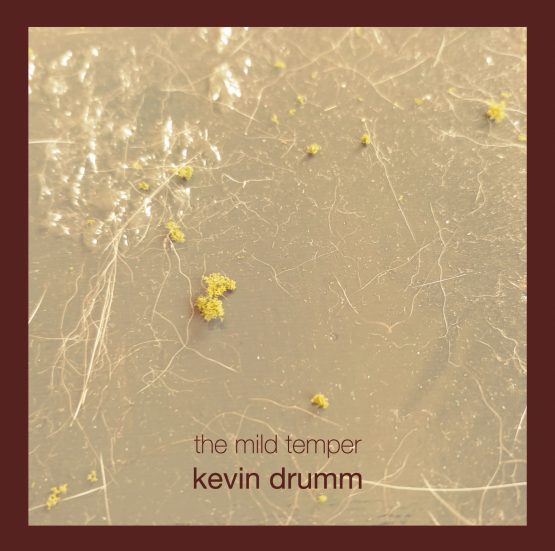
Kevin DRUMM – “The Mild Temper”
45,00 €
For more than thirty years, Kevin Drumm has developed a unique sonic language situated at the intersection of drone, electronics, improvisation and sound abstraction. Continuously evolving, his work has become one of the most distinctive voices in contemporary experimental music.
Comprising more than six hours of music, The Mild Temper presents an extensive collection of pieces built from gradual transformations, micro-acoustic events and frequency-based structures characteristic of Drumm's practice. Across six discs, the music explores varying states of density, resonance and spatiality, reflecting a sustained interest in the physical properties of sound and their perception over extended durations.
The title, The Mild Temper, suggests a quiet force rather than an overt gesture. Sonic materials often appear restrained, held in a delicate balance between stasis and motion. Small shifts gradually alter the acoustic landscape as layers of frequencies emerge, recede and recombine throughout the listening experience.
Avoiding narrative and dramatic development, these works offer immersion in highly detailed sonic environments where every element contributes to the construction of a deeply absorbing listening space. Attention to texture, depth and duration forms the connective thread throughout the collection.
With The Mild Temper, Kevin Drumm continues his exploration of sound as an autonomous phenomenon, presenting a body of work of remarkable coherence that reflects both the singularity and maturity of his artistic practice.
Mastering by Jim O'Rourke
Tracklisting :
1-1 01 Feb 1
1-2 Retina Check
1-3 Etc A
2-1 Eisegesis
2-2 Exegesis
2-3 New Old Card
3-1 The Blind Owl
3-2 Master Of Idealism
4-1 Achromic Pants
4-2 Odd Ways
5-1 Battles In The Snow I
5-2 Battles In The Snow II
6-1 Grey Screen
6-2 \&\\ : \
6-3 \&\\ : \\
Add to cart
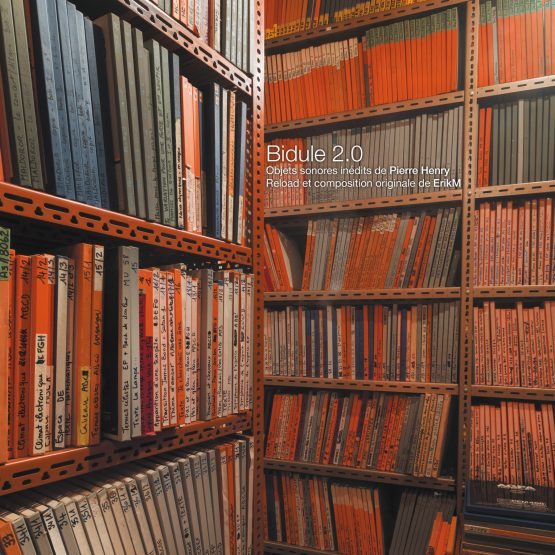
ErikM – “Bidule 2.0”
22,00 €
Unreleased Sound Objects by Pierre Henry / Reload and Original Composition by ErikM
Bidule 2.0 is an unique reinterpretation of Pierre Henry's little-known sound heritage combined with ErikM's original composition. The album explores previously unused raw materials, transformed through ErikM's highly digital approach, balancing fixed composition and unexpected sonic events, a singular sonic experience where where historical archives and contemporary creation converge.
« Bidule 2.0 is a composition by ErikM that revisits a selection of the unused sonic heritage of composer Pierre Henry, covering the period from 1950 to 1974, sourced from the Son/Ré studio and digitized by the BnF (Bibliothèque nationale de France).
Over the decades, Pierre Henry and his team accumulated a vast collection of sonic materials from their studio research.This sound library, recorded on analog tape, is a testimony to the recording techniques of that era — including the quality of microphones and recording media, as well as the acoustics of the recording spaces — all of which define the sound of a time.
Not wanting to create a remix from the composer’s iconic sounds, I chose instead to work with selections of raw material from unused recording sessions, 168 sequences ranging from one to twenty-two minutes each. Isabelle Warnier and Bernadette Mangin provided me with sessions of prepared piano, series of electronic sounds, feedbacks, and voice recordings.
Pierre Henry’s analog sounds were, for the most part, processed through successive stages (up to five generations of transformation), using a custom electronic device: Idiosyncrasie 9.3, built on Max/MSP and Lemur. »
ErikM
Production : CNCM/La Muse en Circuit, Alfortville et INA/GRM Paris
Coproduction : CNCM/GMEM, Marseille
Mastering : Frédéric Alstadt – Angstrom Mastering
A live performance at Présences électronique festival is included on CD version as bonus track.
Add to cart
ErikM – “Bidule 2.0”
13,00 €
Unreleased Sound Objects by Pierre Henry / Reload and Original Composition by ErikM
Bidule 2.0 is an unique reinterpretation of Pierre Henry's little-known sound heritage combined with ErikM's original composition. The album explores previously unused raw materials, transformed through ErikM's highly digital approach, balancing fixed composition and unexpected sonic events, a singular sonic experience where where historical archives and contemporary creation converge.
« Bidule 2.0 is a composition by ErikM that revisits a selection of the unused sonic heritage of composer Pierre Henry, covering the period from 1950 to 1974, sourced from the Son/Ré studio and digitized by the BnF (Bibliothèque nationale de France).
Over the decades, Pierre Henry and his team accumulated a vast collection of sonic materials from their studio research.This sound library, recorded on analog tape, is a testimony to the recording techniques of that era — including the quality of microphones and recording media, as well as the acoustics of the recording spaces — all of which define the sound of a time.
Not wanting to create a remix from the composer’s iconic sounds, I chose instead to work with selections of raw material from unused recording sessions, 168 sequences ranging from one to twenty-two minutes each. Isabelle Warnier and Bernadette Mangin provided me with sessions of prepared piano, series of electronic sounds, feedbacks, and voice recordings.
Pierre Henry’s analog sounds were, for the most part, processed through successive stages (up to five generations of transformation), using a custom electronic device: Idiosyncrasie 9.3, built on Max/MSP and Lemur. »
ErikM
Production : CNCM/La Muse en Circuit, Alfortville et INA/GRM Paris
Coproduction : CNCM/GMEM, Marseille
Mastering : Frédéric Alstadt – Angstrom Mastering
A live performance at Présences électronique festival is included on CD version as bonus track.
Add to cart
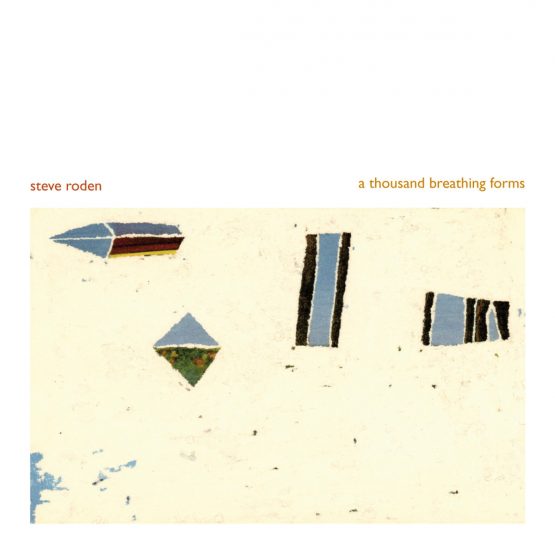
Steve RODEN – “A thousand breathing forms” (2026 reissue)
40,00 €
2026 reissue.
A Thousand Breathing Forms, the second boxset of Steve Roden archive works released by Sonoris, is a selection of unreleased or hard-to-locate works from 2003 to 2008, a very prolific and creative period for the Californian artist. The boxset is centered on his hard-to-describe loop based sound works that are uniquely his own, such as Stars Of Ice (2008), A Christmas Play For Joseph Cornell (2007), but also includes the conceptual "One Hour As The Bumps Of Surfaces" and some more musical or instrumental works. So Delicate And Strangely Made, the title of one of his very first records (2003), could still be the right description of his sound work, rooted in visual arts and architecture, mixing conceptual rigor, and experimentation, without neglecting musicality.
Steve Roden (1964-2023) was a visual and sound artist born in Los Angeles. Roden’s work includes painting, drawing, sculpture, film/video, sound installation, and performance.
Most of Roden’s sound works tend towards using a singular source - such as objects, architectural spaces, field recordings, or texts. These things, become abstracted through humble electronic processes to create new audio spaces, or “possible landscapes”.
Mastering by Giuseppe Ielasi.
"Over the last thirty years, Steve Roden has risen as a singular voice, attacking and advancing the highest challenges of the avant-garde - blurring the lines between nearly every creative field, moving outwardly toward the boundary with every day life. A visual and sound artist, his work spans the fields of painting, drawing, sculpture, film/video, sound installation, and performance.
A pioneer of Lowercase music, a movement which uses amplification as a means to address the quiet and unheard sounds of objects and environments, Steve Roden is one of the great contemporary successors of John Cage. Looking beyond the shadow cast by chance and indeterminacy, he casts the ear toward a world indicated by the composer’s most original, radical, and often neglected idea - the value and beauty of the sounds of non-instrumental sources and of the every day. Through subtle intervention, he has illuminated the path for a rising generation of artist working in sound - refusing categorization, working as comfortably in a museum or gallery, as the contexts of music. Guided by rigorous conceptual perimeters and concerns, across A Thousand Breathing Forms the axis of Roden’s work snaps into view - the monumental presence of the smallest moment and sound.
This boxset, which collects Roden’s unreleased and hard to find works from the incredibly prolific period between 2003 and 2008, is drenched in musicality. Centered around loop based works, it pulls relentlessly and democratically from a seemingly endless world of source - samples of records from an array of cultures, field recordings, instruments, object, and environments. It is a body of work, which, for being birthed electronic process, appears stunningly organic - steeped in humanity and touch. A world of intimacy. The discrete at a towing scale. A realm to be inhabited, which burrows deep - taking residence in the ear. As it sounds, resonances, and structures intertwine, Roden appears as a vision of the future, and a bridge to the past - a breaking of dogma, and a reconciliation for the schism between Minimalism and the conceptualism of Cage. A world guided by ideas, presenting the profound beauty, meaning, and importance of sound, across its six CDs, A Thousand Breathing Forms is a revelation - a lens into the practice and work of an artist of incredible significance, as much as an opening to the larger field. Capturing and advancing some of the most important and difficult ideas of the last hundred years with elegance, accessibility, and grace, this is a collection which promises to grow over time and at every turn."
Bradford Bailey
Add to cart
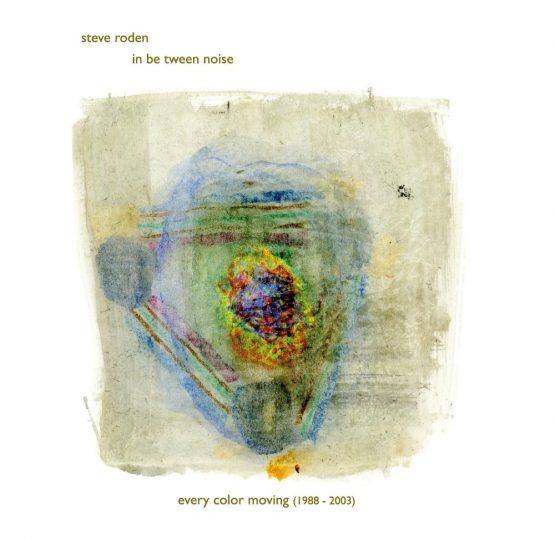
Steve RODEN / In Be Tween Noise – “Every color moving (1988-2003)” (2026 reissue)
40,00 €
2026 reissue.
"Every Color Moving” consists of 6 discs, covering 7 hours of the 15 first years of Steve Roden musical activities. The first 4 discs contain unreleased works and impossible to find small editions. The last 2 discs offer a selection of tracks made for compilations during the same period. From the surprising early experiments to the development of his often imitated but never equalled 'lowercase’ aesthetic, these are some of Roden’s earliest works, documenting numerous rare and unreleased recordings.
The discs are accompanied with a 32 page booklet with an essay and extended track notes, written by the artist.
Steve Roden (1964-2023) was a visual and sound artist born in Los Angeles. Roden’s work includes painting, drawing, sculpture, film/video, sound installation, and performance. Roden’s earliest musical experience was as the singer of the Los Angeles punk band “Seditionaries” from 1978 - 1982, performing locally with some famous bands from this scene. Roden’s early works moved from loud to quiet in the midst of an emotional crisis at age 18, fueling a shift in his work, with the discovery of Eno’s Obscure label. In the early -1990’s Roden discovered the Broken Music catalog (an encyclopedic survey of records related to visual artists), offering a context for an artistic practice rooted in both visual and sound art.
In 1990 Roden released his first recording on a self-released cassette titled “the secret of happiness” under the artist name “in be tween noise”. Since then, Roden has released 45 solo recordings on various labels, alongside numerous collaborations and compilations. By the late 1990’s Roden began to use his own name as the artist of his solo recordings. Most of Roden’s sound works tend towards using a singular source - such as objects, architectural spaces, field recordings, or texts. These things, become abstracted through humble electronic processes to create new audio spaces, or “possible landscapes”. In 2000, he used the term “lowercase” to describe a music that “bears a certain sense of quiet and humility”. Over the years, he has created a rich and diverse body of work that is uniquely his own, mixing conceptual rigor, experimentation and musicality.
Add to cart
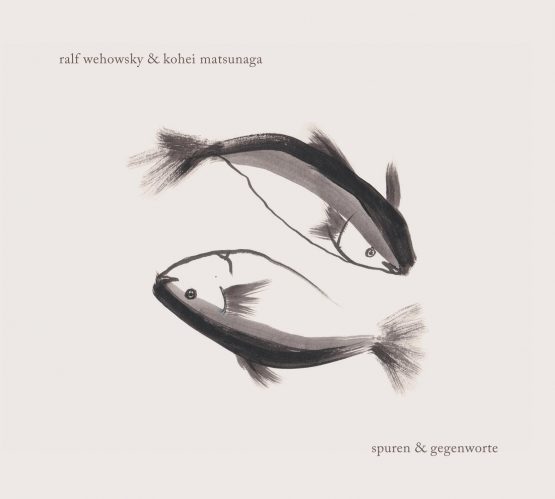
Ralf WEHOWSKY & Kohei MATSUNAGA – “Spuren & Gegenworte”
12,00 €
"Spuren & Gegenworte" began with a quasi-telepathic collaboration between KM and RW. Both recorded a track on May 3, 2021, from 8:00 PM to 8:10 PM. These recordings were subsequently transformed, combined, juxtaposed, and further modified over the course of several months, resulting in the completion of the four pieces on the CD.
"Spuren & Gegenworte" can be translated as "traces & antonyms", opening up a wide range of interpretations. "Traces" may refer to the remnants of the original sounds that have been transformed in the process of reworking, or it can symbolize the cultural and musical influences that can be discerned. "Antonyms" oscillates between contrasting/contradictory and complementary meanings. Of course, other interpretations are also possible.
The 4 titles are indicated as Japanese terms on the cover: 痕跡、対立、変動、補完. They stand for the themes of traces, confrontation, fluctuation, completion.
***
Kohei Matsunaga is a musician and illustrator, born in Osaka in 1978. He has been actively making music since 1992, with notable releases on labels such as Raster Noton, Wordsound, Mille Plateaux, Important Records and PAN. He has collaborated with many artists, including Mika Vainio, Sean Booth from Autechre, Conrad Schnitzler, Merzbow and Asmus Tietchens. He lives in Osaka and Berlin.
Ralf Wehowsky is one of the most respected electronic composers of our day and was also a founder member of the seminal German group P16.D4 and label Selektion whose ground-breaking releases influenced many working in today's experimental music scene. His work is split between solo releases (under the moniker RLW) and collaborations, exploring all fields between media exchange and realtime presence recordings. His music is impossible to pigeonhole into one simple bracket. It is neither industrial or musique concrete, nor computer music nor improvisation. In fact, it could be all of these.
Add to cart
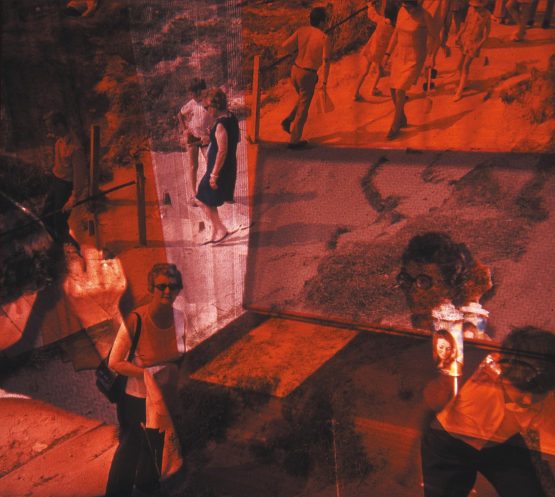
Mark VERNON – “Sheet Erosion”
12,00 €
Audio Archaeology Series Volume 3: Brest
Sheet Erosion is the third episode in a series of works based around ideas of audio archaeology and found sounds. The setting this time is the city of Brest in France.
It is composed of field recordings made in early 2020 during the storms Ciara and Desmond plus a batch of found open-reel tape recordings dating from the 70s and 80s. The tapes include domestic home recordings but mostly document the recordist, Michel's tastes in music and radio programmes of the time. Daily life bleeds into these lo-fi recordings of radio and TV shows. Captured with a mic in front of a speaker rather than directly cabled, ambiguous activities can be heard in the background; babies crying, feedback, chairs scraping and muffled conversations.
In the composition family histories and musical tastes are transposed over a more contemporary soundscape of Brest. Over-saturated tape distorts time as well as sounds. Speeds change. Chronologies become confused. Different instances in time are blended and fused. What seeps through these chronological crevices are events and incidents unmoored from linear time taking place in a chimerical non-space.
***
Mark Vernon is a Glasgow based artist who explores concepts of audio archaeology, magnetic memory and nostalgia through his sound works. At the core of his practice lies a fascination with the intimacy of the radio voice, environmental sound, obsolete media and the reappropriation of found recordings. A rich collection of domestic tape recordings; audio letters, dictated notes, answer-phone messages and other lost voices often find their way into his unorthodox soundworlds. These diverse elements are distilled into radiophonic compositions for broadcast, multi-channel diffusion, fixed media and live performances.
His solo music projects have been published through labels including Kye, Glistening Examples, Flaming Pines, Discrepant, Entr’acte, 3Leaves, Misanthropic Agenda, Canti Magnetici, Granny, Calling Cards Publishing, Psyché Tropes, Persistence of Sound and Gagarin Records, as well as a series of small CDR and LP editions on his own Meagre Resource imprint.
Add to cart
Out of Print
Michèle BOKANOWSKI – “Musiques de concert”
35,00 €
This 4 CD box edition collects all concert musics by Michèle Bokanowski, a composer of electroacoustic music living in Paris, France.
Passionate about music from childhood, it wasn’t until later, at the age of 22, after reading À la recherche d’une musique concrète by Pierre Schaeffer, that she decided to study composition. After classical training in harmony, she met Michel Puig, a pupil of René Leibowitz, who taught her writing and analysis upon Schönberg Theory. In 1970, she began a two-year internship at the Research Department of the ORTF under the direction of Pierre Schaeffer. Between 1973 and 1975, she took part in a research group on sound synthesis, studied computer music at the University of Vincennes as well as electronic music with Éliane Radigue. She mainly composes for concert and for cinema (music for Patrick Bokanowski's short films and for his feature films L'Ange and Un Rêve solaire). She has also composed for television, theatre and dance.
In her music, often infused with a mysterious atmosphere, she uses evocative and poetic concrete sounds, with a mastery of looping and feedback techniques and with an art of cinematic editing.
"Why musique concrète is so attractive to me, as opposed to written music... To write music implies that an idea or a thought is at the origins of the composition and that the final thing is the sound rendering of this thought. The sound is at the end of the line, in other words. Musique concrète is the exact reverse of this process: you start from sounds... sounds that will perhaps lead you to a constructive thought. Here, it’s the material that induces the thought, or the writing. The possibilities of finding or inventing new sounds and, therefore, new forms are tremendous, infinite... Moreover you can use chance to a much greater extent."
(Excerpt of an interview with Michael Karman for Asymmetry Music Magazine 2007)
CD1 :
Pour un pianiste (1974)
Trois chambres d’inquiétude (1976)
Tabou (1984)
CD2 :
Phone variations (1988)
Cirque (1994)
CD3 :
L’étoile absinthe (2000)
Chant d’ombre (2004)
Enfance (2011)
CD4 :
Rhapsodia (2018)
Cadence (2019)*
Elsewhere (2020)*
* unreleased
Mastering by Giuseppe Ielasi.
Read more
P16.D4 – “Distruct”
20,00 €
Distruct
Directed by P16.D4
Assemblage of transformed, organized and (re)structed sound material submitted by:
Bladder Flask, Déficit Des Années Antérieures, De Fabriek, The Haters, Philip Johnson, Hiroki Kocha, Merzbow, Fredrik Nilsen, Nocturnal Emissions, Nurse With Wound, Onnyk, Harold Schellinx, Die Tödliche Doris, Vortex Campaign.
"On this, their second LP, P16.D4 solicited tapes from several artists from Europe, England, the U.S., Canada, and Japan, and mixed that with their own material. Though in the current digital age collaborations from artists thousands of miles apart is quite normal, this was a quite radical approach back in 1982, when work on this LP began – an interesting concept that actually works quite well, since these artists, which include Bladder Flask, DDAA, the Haters, Merzbow, Nocturnal Emissions, Nurse With Wound, and several others – work in a similar free-ranging experimentalism as P16.D4, and their particular elements, usually just vocals or one instrument or noise implement, blend well without diluting P16.D4’s own peculiar brand of avant-garde post-industrialism, but merely give it another facet. One of the best tracks, “Aufmarsch, Heimlich,” consists of a choir submitted anonymously from Eastern Europe phasing in and out of static while a skronky alto sax bleats away. Most of the pieces exist somewhere just beyond the borders of free jazz, industrial, and even classical avant-garde, full of jarring noises and strange transitions and with a heavy overlay of electronics. What started out as an experiment yielded one of P16.D4’s best albums."
Rolf Semprebon / AMG
"Distruct is organized around sounds provided by the cream of experimental musicians of the early '80s, from Nurse With Wound to Nocturnal Emissions, via De Fabriek, Die Todliche Doris, The Haters, Merzbow, and others. Obviously, there is no question of remixing here, and at no time do P16.D4 seek to hide its sources, clearly identifying the contribution of each artist in the liner notes. It would be futile to try to find the paw of each artist, the trio operating vis-à-vis its collaborators the same methods as in their own work. Reworked, distorted by various effects, cut, edited, aggregated with other sounds, produced by P16.D4 themselves, reprocessed. Exchange, communication, two other data that will constantly recur in the work of P16.D4, rich in external contributions and encounters of all kinds. Musically, and despite the diversity of sources treated, Distruct escapes the heterogeneous character, which often marks this type of collaboration, to offer a coherent whole: fragments of opera, Soviet speeches, out-of-tune guitar, saxophone, tattered violins, overdriven and metallic noisy attacks, jackhammers, field recordings, battered choirs, and many other less identifiable sounds. In addition to the desired dialogue between the artists, Distruct also offers a real reflection on listening, and on the expectations of the listener."
Dissolve
P16.D4 was a German electronic noise music collective, active primarily from 1980 to 1988. P16.D4 embraced tape cut-ups, musique concrète, endless recycling and transformation of previously published material, and many long-distance collaborations with like-minded artists such as DDAA, Vortex Campaign, Nurse With Wound, and Merzbow. Their active participation in the international industrial tape scene yielded collaborative output such as their release Distruct, where bands such as Nurse with Wound, Nocturnal Emissions, Die Tödliche Doris, and The Haters provided the source material. The longest-term collaboration was with the installation and conceptual artist Achim Wollscheid, who used P16.D4 sounds as the basis for LPs he recorded under the name SBOTHI. Ralf Wehowsky, the only constant member of the group, later released solo material under the alias RLW. Members of P16.D4 were also involved with Selektion, a collective of people involved with sound as well as the visual arts. Selektion published LPs, CDs, books, visual art and design. The collective worked in a strongly improvised, spontaneous and anti-professional way, using acoustic and electronic instruments, using existing sound fragments, duplicating and alienating them, using repetition, distortion, changes in speed and playing direction. For this they used not only sounds of other artists but also their own material from earlier productions. Late works of the collective are associated with musique concrete.
Add to cart
P16.D4 was a German electronic noise music collective, active primarily from 1980 to 1988. P16.D4 embraced tape cut-ups, musique concrète, endless recycling and transformation of previously published material, and many long-distance collaborations with like-minded artists such as DDAA, Vortex Campaign, Nurse With Wound, and Merzbow. Their active participation in the international industrial tape scene yielded collaborative output such as their release Distruct, where bands such as Nurse with Wound, Nocturnal Emissions, Die Tödliche Doris, and The Haters provided the source material. The longest-term collaboration was with the installation and conceptual artist Achim Wollscheid, who used P16.D4 sounds as the basis for LPs he recorded under the name SBOTHI. Ralf Wehowsky, the only constant member of the group, later released solo material under the alias RLW. Members of P16.D4 were also involved with Selektion, a collective of people involved with sound as well as the visual arts. Selektion published LPs, CDs, books, visual art and design. The collective worked in a strongly improvised, spontaneous and anti-professional way, using acoustic and electronic instruments, using existing sound fragments, duplicating and alienating them, using repetition, distortion, changes in speed and playing direction. For this they used not only sounds of other artists but also their own material from earlier productions. Late works of the collective are associated with musique concrete.
P16.D4 – “Distruct”
12,00 €
Distruct
Directed by P16.D4
Assemblage of transformed, organized and (re)structed sound material submitted by:
Bladder Flask, Déficit Des Années Antérieures, De Fabriek, The Haters, Philip Johnson, Hiroki Kocha, Merzbow, Fredrik Nilsen, Nocturnal Emissions, Nurse With Wound, Onnyk, Harold Schellinx, Die Tödliche Doris, Vortex Campaign.
"On this, their second LP, P16.D4 solicited tapes from several artists from Europe, England, the U.S., Canada, and Japan, and mixed that with their own material. Though in the current digital age collaborations from artists thousands of miles apart is quite normal, this was a quite radical approach back in 1982, when work on this LP began – an interesting concept that actually works quite well, since these artists, which include Bladder Flask, DDAA, the Haters, Merzbow, Nocturnal Emissions, Nurse With Wound, and several others – work in a similar free-ranging experimentalism as P16.D4, and their particular elements, usually just vocals or one instrument or noise implement, blend well without diluting P16.D4’s own peculiar brand of avant-garde post-industrialism, but merely give it another facet. One of the best tracks, “Aufmarsch, Heimlich,” consists of a choir submitted anonymously from Eastern Europe phasing in and out of static while a skronky alto sax bleats away. Most of the pieces exist somewhere just beyond the borders of free jazz, industrial, and even classical avant-garde, full of jarring noises and strange transitions and with a heavy overlay of electronics. What started out as an experiment yielded one of P16.D4’s best albums."
Rolf Semprebon / AMG
"Distruct is organized around sounds provided by the cream of experimental musicians of the early '80s, from Nurse With Wound to Nocturnal Emissions, via De Fabriek, Die Todliche Doris, The Haters, Merzbow, and others. Obviously, there is no question of remixing here, and at no time do P16.D4 seek to hide its sources, clearly identifying the contribution of each artist in the liner notes. It would be futile to try to find the paw of each artist, the trio operating vis-à-vis its collaborators the same methods as in their own work. Reworked, distorted by various effects, cut, edited, aggregated with other sounds, produced by P16.D4 themselves, reprocessed. Exchange, communication, two other data that will constantly recur in the work of P16.D4, rich in external contributions and encounters of all kinds. Musically, and despite the diversity of sources treated, Distruct escapes the heterogeneous character, which often marks this type of collaboration, to offer a coherent whole: fragments of opera, Soviet speeches, out-of-tune guitar, saxophone, tattered violins, overdriven and metallic noisy attacks, jackhammers, field recordings, battered choirs, and many other less identifiable sounds. In addition to the desired dialogue between the artists, Distruct also offers a real reflection on listening, and on the expectations of the listener."
Dissolve
P16.D4 was a German electronic noise music collective, active primarily from 1980 to 1988. P16.D4 embraced tape cut-ups, musique concrète, endless recycling and transformation of previously published material, and many long-distance collaborations with like-minded artists such as DDAA, Vortex Campaign, Nurse With Wound, and Merzbow. Their active participation in the international industrial tape scene yielded collaborative output such as their release Distruct, where bands such as Nurse with Wound, Nocturnal Emissions, Die Tödliche Doris, and The Haters provided the source material. The longest-term collaboration was with the installation and conceptual artist Achim Wollscheid, who used P16.D4 sounds as the basis for LPs he recorded under the name SBOTHI. Ralf Wehowsky, the only constant member of the group, later released solo material under the alias RLW. Members of P16.D4 were also involved with Selektion, a collective of people involved with sound as well as the visual arts. Selektion published LPs, CDs, books, visual art and design. The collective worked in a strongly improvised, spontaneous and anti-professional way, using acoustic and electronic instruments, using existing sound fragments, duplicating and alienating them, using repetition, distortion, changes in speed and playing direction. For this they used not only sounds of other artists but also their own material from earlier productions. Late works of the collective are associated with musique concrete.
Add to cart
P16.D4 was a German electronic noise music collective, active primarily from 1980 to 1988. P16.D4 embraced tape cut-ups, musique concrète, endless recycling and transformation of previously published material, and many long-distance collaborations with like-minded artists such as DDAA, Vortex Campaign, Nurse With Wound, and Merzbow. Their active participation in the international industrial tape scene yielded collaborative output such as their release Distruct, where bands such as Nurse with Wound, Nocturnal Emissions, Die Tödliche Doris, and The Haters provided the source material. The longest-term collaboration was with the installation and conceptual artist Achim Wollscheid, who used P16.D4 sounds as the basis for LPs he recorded under the name SBOTHI. Ralf Wehowsky, the only constant member of the group, later released solo material under the alias RLW. Members of P16.D4 were also involved with Selektion, a collective of people involved with sound as well as the visual arts. Selektion published LPs, CDs, books, visual art and design. The collective worked in a strongly improvised, spontaneous and anti-professional way, using acoustic and electronic instruments, using existing sound fragments, duplicating and alienating them, using repetition, distortion, changes in speed and playing direction. For this they used not only sounds of other artists but also their own material from earlier productions. Late works of the collective are associated with musique concrete.
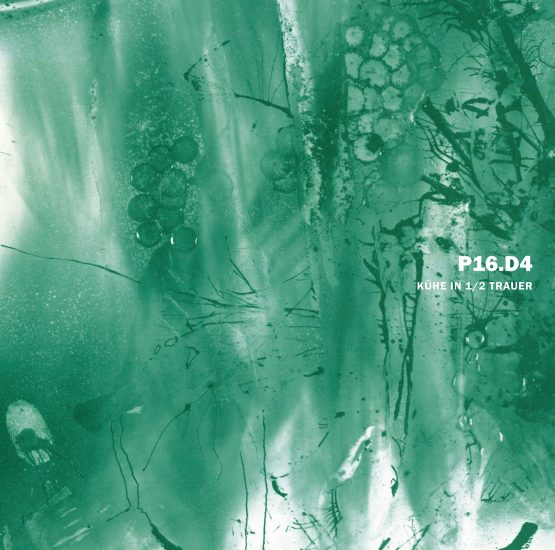
P16.D4 – “Kühe in 1/2 trauer”
20,00 €
"This music is staggeringly original and innovative, and while it's possible to locate it in a chain of circumstance that links it to 'Industrial' music, P16.D4 indulged in none of the empty cliches associated with the genre, worked incredibly hard, and seem to have been aiming at a form of sound art that was much more profound, varied, subversive, and potentially dangerous. Kuhe In 1/2 Trauer's accompanying credits indicate their radical approach to making music: lots of improvisation, lots of live electronics, extensive use of tape-loops, some conventional instrumentation, and much that isn't – like the milk churn on 'Paris, Morgue' or the use of baking tray and washing machine elsewhere. Even when guitars, drums or keyboards are used, they're played very weirdly. It's not even made clear who was doing what; the main credit is 'Concept,' which I assume means that one of the three devised the framework in which the noise would operate itself, and while RLW gets the lion's share of these credits, a lot of the cuts are evenly divided among the team and I have no doubt that the group operated in a very democratic or libertarian manner. None of this prepares you for the insane and troubling sounds that reach your ears, composed with scant regard for conventional logic and following an exciting, absurdist path, especially in the matter of tape edits and juxtapositions of recordings."
Ed Pinsent, The Sound Projector.
"Though this German group started out as a the new wave band P.D., by the time of Kuhe in 1/2 Trauer, their first LP under the P16.D4 name from 1984, they had developed far beyond into extremely experimental music similar to other post-industrial artists working with abstract avant-garde soundscapes. There's a bleak industrial feel to the gritty, lo-fi electronics and tape loops, while the group throws in enough curve balls to keep it interesting. On some pieces, strange, looped choirs bubble out of throbbing pulses and drones of feedback, while others have clanging and clattering, and elements of musique concrète and improvisation blur the boundaries even further. The opening track, "Default Value," is one of those disorienting pieces with noises flying everywhere, while "Paris Morgue" takes excerpts from one of their old P.D. tracks and messes it up with additional instruments, while the ungainly titled fourth track throws in a heavy texture of percussive noises to create an edgy ambience about to teeter off the edge, and the even darker and more ambient title track takes the tension even further. Arrhythmic and amorphous and capable at moments of becoming quite noisy and abrasive, while at others far more somber and quiet, Kuhe in 1/2 Trauer is quite a fascinating release."
Rolf Semprebon / AMG
P16.D4 was a German electronic noise music collective, active primarily from 1980 to 1988. P16.D4 embraced tape cut-ups, musique concrète, endless recycling and transformation of previously published material, and many long-distance collaborations with like-minded artists such as DDAA, Vortex Campaign, Nurse With Wound, and Merzbow. Their active participation in the international industrial tape scene yielded collaborative output such as their release Distruct, where bands such as Nurse with Wound, Nocturnal Emissions, Die Tödliche Doris, and The Haters provided the source material. The longest-term collaboration was with the installation and conceptual artist Achim Wollscheid, who used P16.D4 sounds as the basis for LPs he recorded under the name SBOTHI. Ralf Wehowsky, the only constant member of the group, later released solo material under the alias RLW. Members of P16.D4 were also involved with Selektion, a collective of people involved with sound as well as the visual arts. Selektion published LPs, CDs, books, visual art and design. The collective worked in a strongly improvised, spontaneous and anti-professional way, using acoustic and electronic instruments, using existing sound fragments, duplicating and alienating them, using repetition, distortion, changes in speed and playing direction. For this they used not only sounds of other artists but also their own material from earlier productions. Late works of the collective are associated with musique concrete.
Add to cart
P16.D4 was a German electronic noise music collective, active primarily from 1980 to 1988. P16.D4 embraced tape cut-ups, musique concrète, endless recycling and transformation of previously published material, and many long-distance collaborations with like-minded artists such as DDAA, Vortex Campaign, Nurse With Wound, and Merzbow. Their active participation in the international industrial tape scene yielded collaborative output such as their release Distruct, where bands such as Nurse with Wound, Nocturnal Emissions, Die Tödliche Doris, and The Haters provided the source material. The longest-term collaboration was with the installation and conceptual artist Achim Wollscheid, who used P16.D4 sounds as the basis for LPs he recorded under the name SBOTHI. Ralf Wehowsky, the only constant member of the group, later released solo material under the alias RLW. Members of P16.D4 were also involved with Selektion, a collective of people involved with sound as well as the visual arts. Selektion published LPs, CDs, books, visual art and design. The collective worked in a strongly improvised, spontaneous and anti-professional way, using acoustic and electronic instruments, using existing sound fragments, duplicating and alienating them, using repetition, distortion, changes in speed and playing direction. For this they used not only sounds of other artists but also their own material from earlier productions. Late works of the collective are associated with musique concrete.
P16.D4 – “Kühe in 1/2 trauer”
12,00 €
6-panel digipak.
"This music is staggeringly original and innovative, and while it's possible to locate it in a chain of circumstance that links it to 'Industrial' music, P16.D4 indulged in none of the empty cliches associated with the genre, worked incredibly hard, and seem to have been aiming at a form of sound art that was much more profound, varied, subversive, and potentially dangerous. Kuhe In 1/2 Trauer's accompanying credits indicate their radical approach to making music: lots of improvisation, lots of live electronics, extensive use of tape-loops, some conventional instrumentation, and much that isn't – like the milk churn on 'Paris, Morgue' or the use of baking tray and washing machine elsewhere. Even when guitars, drums or keyboards are used, they're played very weirdly. It's not even made clear who was doing what; the main credit is 'Concept,' which I assume means that one of the three devised the framework in which the noise would operate itself, and while RLW gets the lion's share of these credits, a lot of the cuts are evenly divided among the team and I have no doubt that the group operated in a very democratic or libertarian manner. None of this prepares you for the insane and troubling sounds that reach your ears, composed with scant regard for conventional logic and following an exciting, absurdist path, especially in the matter of tape edits and juxtapositions of recordings."
Ed Pinsent, The Sound Projector.
"Though this German group started out as a the new wave band P.D., by the time of Kuhe in 1/2 Trauer, their first LP under the P16.D4 name from 1984, they had developed far beyond into extremely experimental music similar to other post-industrial artists working with abstract avant-garde soundscapes. There's a bleak industrial feel to the gritty, lo-fi electronics and tape loops, while the group throws in enough curve balls to keep it interesting. On some pieces, strange, looped choirs bubble out of throbbing pulses and drones of feedback, while others have clanging and clattering, and elements of musique concrète and improvisation blur the boundaries even further. The opening track, "Default Value," is one of those disorienting pieces with noises flying everywhere, while "Paris Morgue" takes excerpts from one of their old P.D. tracks and messes it up with additional instruments, while the ungainly titled fourth track throws in a heavy texture of percussive noises to create an edgy ambience about to teeter off the edge, and the even darker and more ambient title track takes the tension even further. Arrhythmic and amorphous and capable at moments of becoming quite noisy and abrasive, while at others far more somber and quiet, Kuhe in 1/2 Trauer is quite a fascinating release."
Rolf Semprebon / AMG
P16.D4 was a German electronic noise music collective, active primarily from 1980 to 1988. P16.D4 embraced tape cut-ups, musique concrète, endless recycling and transformation of previously published material, and many long-distance collaborations with like-minded artists such as DDAA, Vortex Campaign, Nurse With Wound, and Merzbow. Their active participation in the international industrial tape scene yielded collaborative output such as their release Distruct, where bands such as Nurse with Wound, Nocturnal Emissions, Die Tödliche Doris, and The Haters provided the source material. The longest-term collaboration was with the installation and conceptual artist Achim Wollscheid, who used P16.D4 sounds as the basis for LPs he recorded under the name SBOTHI. Ralf Wehowsky, the only constant member of the group, later released solo material under the alias RLW. Members of P16.D4 were also involved with Selektion, a collective of people involved with sound as well as the visual arts. Selektion published LPs, CDs, books, visual art and design. The collective worked in a strongly improvised, spontaneous and anti-professional way, using acoustic and electronic instruments, using existing sound fragments, duplicating and alienating them, using repetition, distortion, changes in speed and playing direction. For this they used not only sounds of other artists but also their own material from earlier productions. Late works of the collective are associated with musique concrete.
Add to cart
P16.D4 was a German electronic noise music collective, active primarily from 1980 to 1988. P16.D4 embraced tape cut-ups, musique concrète, endless recycling and transformation of previously published material, and many long-distance collaborations with like-minded artists such as DDAA, Vortex Campaign, Nurse With Wound, and Merzbow. Their active participation in the international industrial tape scene yielded collaborative output such as their release Distruct, where bands such as Nurse with Wound, Nocturnal Emissions, Die Tödliche Doris, and The Haters provided the source material. The longest-term collaboration was with the installation and conceptual artist Achim Wollscheid, who used P16.D4 sounds as the basis for LPs he recorded under the name SBOTHI. Ralf Wehowsky, the only constant member of the group, later released solo material under the alias RLW. Members of P16.D4 were also involved with Selektion, a collective of people involved with sound as well as the visual arts. Selektion published LPs, CDs, books, visual art and design. The collective worked in a strongly improvised, spontaneous and anti-professional way, using acoustic and electronic instruments, using existing sound fragments, duplicating and alienating them, using repetition, distortion, changes in speed and playing direction. For this they used not only sounds of other artists but also their own material from earlier productions. Late works of the collective are associated with musique concrete.
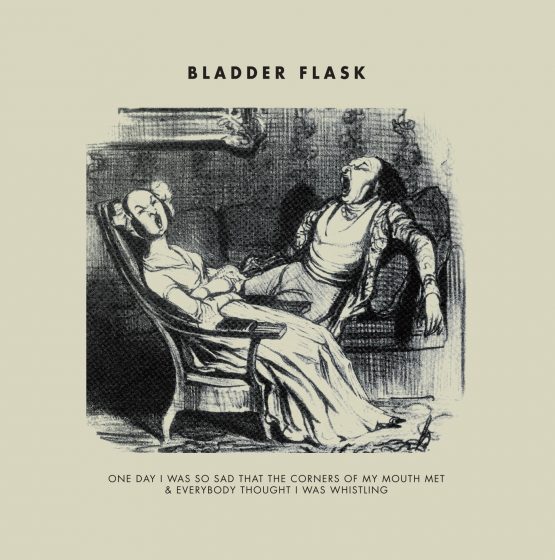
BLADDER FLASK – “One Day I Was So Sad …”
20,00 €
Bladder Flask
"One Day I Was So Sad That The Corners Of My Mouth Met & Everybody Thought I Was Whistling"
Bladder Flask's debut (in fact only) LP, originally issued by Orgel Fesper Music in 1981, is one of the most eclectic albums of the post-Industrial era. It is both challenging and perplexing... So, put down your puny instruments of normality and breathe in the frenzied fungal spores of Bladder Flask!
The fact that Steven Stapleton of Nurse With Wound is a big fan of this album is testament to its greatness:
'I love Bladder Flask's One Day I Was So Sad That The Corners Of My Mouth Met & Everybody Thought I Was Whistling and what a great title, perhaps my favourite ever. I must have listened to the album so much in the '80s. I listened to it again recently and it was like welcoming an old friend.'
Personnel: Richard Rupenus, Philip Rupenus + Sean Breadin, John Mylotte, Nigel Jacklin
Recorded at Wrongrong Studio and Spectro Arts Workshop 1980 – 1981
Audio Restoration & Mastering: Colin Potter @ IC Studio
LP tracklisting :
I: It Takes A Bliss
II: Musical Behind Head
A selection of comments & reviews: Very scrap merchant, very Dada... Comparisons could be made to NWW's Merzbild Schwet: a mixture of Musique Concrete and instrumental collages, but more intense and compact than NWW. An extremely interesting album and very cleverly done, especially the editing of complex tape treatments. Neumusik A puzzlingly great album. Ah, the halcyon days of bungled Kurt Weill renditions, overactive splicing hands and tape-loops lasting only a few seconds before being smudged by hyper fast-forwarding, like a random, operatic battle of thermopylae as re-created by members of NWW. Faced with omnipresent latter-day refined-aesthetic cognescenti, whose duty it is to remind one of the gravity of modern music, I find myself defending such gut-level joyous stupidity and its gung-ho determination to vertiginously swirl about all manner of daft sundries, with no regard for the mess that may be left afterwards. This is why I like this stuff and some of the worries of the world can be, if not alleviated, at least disguised in the scent of Bladder Flask's audio compost pot-pourri. Bananafish A masterpiece of unrestrained Dada music, Musique Concrete and Electro-Acoustic Improv. Primitive electronics meet the sounds, or rather shreds thereof, of various acoustic instruments, field recordings, found objects, mysterious devices as well as body slapping, whistles and smacks. An augury of what the radicals of Electro-Acoustic music do nowadays, but here you also get surreal humour that could safely rank alongside the best, wildest works of NWW. Activists One Day I Was So Sad... comprises two side-long tracks of extended Dadaist reverie, a sublime mix of Musique Concrete and instrumental collages. Bladder Flask and their ilk were spiritual forefathers to today's 'clicks and cuts' generation, creating a slapdash Industrial experimental music which exploited the idiosyncrasies of analogue tape assemblage and editing. I love this album to pieces and it gets my highest recommendation. Other Music This packs a helluva lot into its generous playing-time. The side-long 'It Takes A Bliss' ranges from free sounding structures of various instruments (played with relish) to a sometimes unnerving encounter with distorted piano strings, guitars and less identifyable sounds. The chemistry which prevents this from becoming self-indulgent is what makes Bladder Flask tick. They wind through an unsettling amount of images and the recording, mixing and editing must have taken a very long time. Most of the music is very spontaneous with even 'Goon' type voices appearing before being shredded by the next 'act.' It's like a successive queue of cameos all awaiting and clambering for your attention. Side two, 'Musical Behind Head,' has slightly more direction and cohesion (or perhaps I just began to adjust to the music?) I was rather stupefied by the contents of this strange menagerie of experimental dialogue. A unique album. Outlet Mind-boggling Fluxus, Dada, Improv, Sound Art and cut-up queasy lunacy. When the LP was originally issued in 1981 it left all those who heard it (including an awe struck Steven Stapleton) flat on their backs. Its two sides of collage combines spoken word samples, people shouting and going mad, hammered piano keys, strummed, out of tune guitars, honking saxophones, wheezy melodicas, sci-fi bloops, tape splurge, preset keyboard beats, train whistles, rattled cutlery drawers, clockwork toys, clanging steel pipes, records spinning at the wrong speed. A myriad of juxtaposed sounds and atmospheres of utter strangeness and beguiling entropy. A sound world that up until 1981 I doubt barely existed. An intriguing, delightful and, at times, unsettling experience. Idwal Fisher One Day I Was So Sad... is that ne plus ultra of cut-up sound art. It is an extremely strange - at times, quite hilarious - experiment in fast-moving cut-ups. Its sheer incoherence starts from the get-go and doesn't release its hold on your poor cerebellum until you too are dragged down to a state of lunatic frenzy. It's not a record you would play for fun, but its fractured consciousness, incoherence, and sheer Dadaist lunacy are considerable. God alone knows what sources were used to create it: screaming and coughing, all-manner of acoustic instruments are mauled and mutilated; a trumpet blown by a fat whaler, violins scraped by cretinous monkeys. Aiming for maximum disorientation, it challenges you to keep up with its restless and intense flow of ideas and you're challenged to see past the apparent silliness of it all. Sourced presumably from multiple found sounds, tapes, and records, the piece was assembled in a deliberately fragmented fashion, each sample lasting only a few seconds and bearing no connection whatever to the next. One of the striking aspects of this concoction is the odd and ill-fitting mix of vulgar, crass humour with moments of near-pathological darkness. It's like watching a slapstick movie from the 1930s spliced with a low-budget Italian zombie movie – custard pie fights morphing into monstrous flesh-eating, similar to how Dali and Bunuel claimed that they assembled the first Surrealist movie, Un Chien Andalou. You're pulled in both directions at once until you can hear your own sinews snapping. It's not a record you would play for fun, but its fractured consciousness, incoherence, and sheer Dadaist lunacy are considerable. It's as if Bladder Flask were possessed by some fevered desire to surpass the worst excesses of the lunatic fringe end of the United Dairies catalogue. But this LP had the underlying sinister aim of sending all those who heard it mad, through highlighting the complete absurdity and futility of everything. A gibbering masterpiece. The Sound Projector One Day I Was So Sad... comprises, for the most part, a series of short collages which are seemingly disparate and fragmented: humorous vocal exercises, detuned piano, excerpts from Pop music and Free Jazz, electronics, tape-loops, accelerated scrolling of tapes, excerpts from film dialogues, among a thousand other things that are more difficult to identify. The flirtation with Dadaism, in particular the humour, joyful absurdity and disparate elements, is obvious. Virtuosity doesn't seem to be of any concern to the 'musicians' and it seems rather inconceivable that Bladder Flask are themselves the performers of all that can be heard. Although apparently totally random, the structure, if it can be called that, is more complex than it first appears and this is in fact a very meticulous work which must have been extremely laborious considering all the tape-splicing and editing involved. Industrial Musics One Day I Was So Sad... is one of those records which could be described as abstract but it's much more than that with elements of Musique Concrete, Free Jazz and Free Improvisation although it doesn't sit comfortably in any particular genre. It has a total disregard for the constraints of Western music, be it song structure, tunes, harmony, scales, metrics, notations and other rules which are generally followed by musicians who pretentiously pose as experimental. To accurately describe this album would be very difficult, if not impossible. However, if you're looking for comparisons then I'd have to mention other records of an extreme, free-form nature such as The Faust Tapes or, maybe the most fitting of all, Frank Zappa's 'Nasal Retentive Calliope Music' which is one of the first and best examples of 'maniac' tape-manipulation. One Day I Was So Sad... is one of the most genuinely experimental (in the true sense of the word) records ever conceived and will appeal to those who like to push musical boundaries as far as possible. The fact that Steven Stapleton of NWW, who is considered by many to be a genius of experimentation and a living encyclopaedia of all things avant-garde, is a big fan of this album is proof of its greatness. One Day I Was So Sad... is a masterpiece of experimentation and a totally unclassifiable record. Debaser
Add to cart
A selection of comments & reviews: Very scrap merchant, very Dada... Comparisons could be made to NWW's Merzbild Schwet: a mixture of Musique Concrete and instrumental collages, but more intense and compact than NWW. An extremely interesting album and very cleverly done, especially the editing of complex tape treatments. Neumusik A puzzlingly great album. Ah, the halcyon days of bungled Kurt Weill renditions, overactive splicing hands and tape-loops lasting only a few seconds before being smudged by hyper fast-forwarding, like a random, operatic battle of thermopylae as re-created by members of NWW. Faced with omnipresent latter-day refined-aesthetic cognescenti, whose duty it is to remind one of the gravity of modern music, I find myself defending such gut-level joyous stupidity and its gung-ho determination to vertiginously swirl about all manner of daft sundries, with no regard for the mess that may be left afterwards. This is why I like this stuff and some of the worries of the world can be, if not alleviated, at least disguised in the scent of Bladder Flask's audio compost pot-pourri. Bananafish A masterpiece of unrestrained Dada music, Musique Concrete and Electro-Acoustic Improv. Primitive electronics meet the sounds, or rather shreds thereof, of various acoustic instruments, field recordings, found objects, mysterious devices as well as body slapping, whistles and smacks. An augury of what the radicals of Electro-Acoustic music do nowadays, but here you also get surreal humour that could safely rank alongside the best, wildest works of NWW. Activists One Day I Was So Sad... comprises two side-long tracks of extended Dadaist reverie, a sublime mix of Musique Concrete and instrumental collages. Bladder Flask and their ilk were spiritual forefathers to today's 'clicks and cuts' generation, creating a slapdash Industrial experimental music which exploited the idiosyncrasies of analogue tape assemblage and editing. I love this album to pieces and it gets my highest recommendation. Other Music This packs a helluva lot into its generous playing-time. The side-long 'It Takes A Bliss' ranges from free sounding structures of various instruments (played with relish) to a sometimes unnerving encounter with distorted piano strings, guitars and less identifyable sounds. The chemistry which prevents this from becoming self-indulgent is what makes Bladder Flask tick. They wind through an unsettling amount of images and the recording, mixing and editing must have taken a very long time. Most of the music is very spontaneous with even 'Goon' type voices appearing before being shredded by the next 'act.' It's like a successive queue of cameos all awaiting and clambering for your attention. Side two, 'Musical Behind Head,' has slightly more direction and cohesion (or perhaps I just began to adjust to the music?) I was rather stupefied by the contents of this strange menagerie of experimental dialogue. A unique album. Outlet Mind-boggling Fluxus, Dada, Improv, Sound Art and cut-up queasy lunacy. When the LP was originally issued in 1981 it left all those who heard it (including an awe struck Steven Stapleton) flat on their backs. Its two sides of collage combines spoken word samples, people shouting and going mad, hammered piano keys, strummed, out of tune guitars, honking saxophones, wheezy melodicas, sci-fi bloops, tape splurge, preset keyboard beats, train whistles, rattled cutlery drawers, clockwork toys, clanging steel pipes, records spinning at the wrong speed. A myriad of juxtaposed sounds and atmospheres of utter strangeness and beguiling entropy. A sound world that up until 1981 I doubt barely existed. An intriguing, delightful and, at times, unsettling experience. Idwal Fisher One Day I Was So Sad... is that ne plus ultra of cut-up sound art. It is an extremely strange - at times, quite hilarious - experiment in fast-moving cut-ups. Its sheer incoherence starts from the get-go and doesn't release its hold on your poor cerebellum until you too are dragged down to a state of lunatic frenzy. It's not a record you would play for fun, but its fractured consciousness, incoherence, and sheer Dadaist lunacy are considerable. God alone knows what sources were used to create it: screaming and coughing, all-manner of acoustic instruments are mauled and mutilated; a trumpet blown by a fat whaler, violins scraped by cretinous monkeys. Aiming for maximum disorientation, it challenges you to keep up with its restless and intense flow of ideas and you're challenged to see past the apparent silliness of it all. Sourced presumably from multiple found sounds, tapes, and records, the piece was assembled in a deliberately fragmented fashion, each sample lasting only a few seconds and bearing no connection whatever to the next. One of the striking aspects of this concoction is the odd and ill-fitting mix of vulgar, crass humour with moments of near-pathological darkness. It's like watching a slapstick movie from the 1930s spliced with a low-budget Italian zombie movie – custard pie fights morphing into monstrous flesh-eating, similar to how Dali and Bunuel claimed that they assembled the first Surrealist movie, Un Chien Andalou. You're pulled in both directions at once until you can hear your own sinews snapping. It's not a record you would play for fun, but its fractured consciousness, incoherence, and sheer Dadaist lunacy are considerable. It's as if Bladder Flask were possessed by some fevered desire to surpass the worst excesses of the lunatic fringe end of the United Dairies catalogue. But this LP had the underlying sinister aim of sending all those who heard it mad, through highlighting the complete absurdity and futility of everything. A gibbering masterpiece. The Sound Projector One Day I Was So Sad... comprises, for the most part, a series of short collages which are seemingly disparate and fragmented: humorous vocal exercises, detuned piano, excerpts from Pop music and Free Jazz, electronics, tape-loops, accelerated scrolling of tapes, excerpts from film dialogues, among a thousand other things that are more difficult to identify. The flirtation with Dadaism, in particular the humour, joyful absurdity and disparate elements, is obvious. Virtuosity doesn't seem to be of any concern to the 'musicians' and it seems rather inconceivable that Bladder Flask are themselves the performers of all that can be heard. Although apparently totally random, the structure, if it can be called that, is more complex than it first appears and this is in fact a very meticulous work which must have been extremely laborious considering all the tape-splicing and editing involved. Industrial Musics One Day I Was So Sad... is one of those records which could be described as abstract but it's much more than that with elements of Musique Concrete, Free Jazz and Free Improvisation although it doesn't sit comfortably in any particular genre. It has a total disregard for the constraints of Western music, be it song structure, tunes, harmony, scales, metrics, notations and other rules which are generally followed by musicians who pretentiously pose as experimental. To accurately describe this album would be very difficult, if not impossible. However, if you're looking for comparisons then I'd have to mention other records of an extreme, free-form nature such as The Faust Tapes or, maybe the most fitting of all, Frank Zappa's 'Nasal Retentive Calliope Music' which is one of the first and best examples of 'maniac' tape-manipulation. One Day I Was So Sad... is one of the most genuinely experimental (in the true sense of the word) records ever conceived and will appeal to those who like to push musical boundaries as far as possible. The fact that Steven Stapleton of NWW, who is considered by many to be a genius of experimentation and a living encyclopaedia of all things avant-garde, is a big fan of this album is proof of its greatness. One Day I Was So Sad... is a masterpiece of experimentation and a totally unclassifiable record. Debaser
BLADDER FLASK – “One Day I Was So Sad …”
12,00 €
Bladder Flask "One Day I Was So Sad That The Corners Of My Mouth Met & Everybody Thought I Was Whistling"
Bladder Flask's debut (in fact only) LP, originally issued by Orgel Fesper Music in 1981, is one of the most eclectic albums of the post-Industrial era. It is both challenging and perplexing... So, put down your puny instruments of normality and breathe in the frenzied fungal spores of Bladder Flask!
The fact that Steven Stapleton of Nurse With Wound is a big fan of this album is testament to its greatness:
'I love Bladder Flask's One Day I Was So Sad That The Corners Of My Mouth Met & Everybody Thought I Was Whistling and what a great title, perhaps my favourite ever. I must have listened to the album so much in the '80s. I listened to it again recently and it was like welcoming an old friend.'
Personnel: Richard Rupenus, Philip Rupenus + Sean Breadin, John Mylotte, Nigel Jacklin
Recorded at Wrongrong Studio and Spectro Arts Workshop 1980 – 1981
Audio Restoration & Mastering: Colin Potter @ IC Studio
CD tracklisting :
I: It Takes A Bliss
II: Musical Behind Head
Bonus tracks:
III. The Groping Fingers Of This Vulgar Intruder Have Strummed The Toppling Byzantine Organ Of His Mind
IV: I Am As I Have Spoken
V: Zzzeut-Zzt-Zzt-Zzt (Pour Chapeaux, Manteaux Et Parapluies)
(III: intented to be released on United Dairies, IV/V: released as 7" by Anomalous Records)
A selection of comments & reviews: Very scrap merchant, very Dada... Comparisons could be made to NWW's Merzbild Schwet: a mixture of Musique Concrete and instrumental collages, but more intense and compact than NWW. An extremely interesting album and very cleverly done, especially the editing of complex tape treatments. Neumusik A puzzlingly great album. Ah, the halcyon days of bungled Kurt Weill renditions, overactive splicing hands and tape-loops lasting only a few seconds before being smudged by hyper fast-forwarding, like a random, operatic battle of thermopylae as re-created by members of NWW. Faced with omnipresent latter-day refined-aesthetic cognescenti, whose duty it is to remind one of the gravity of modern music, I find myself defending such gut-level joyous stupidity and its gung-ho determination to vertiginously swirl about all manner of daft sundries, with no regard for the mess that may be left afterwards. This is why I like this stuff and some of the worries of the world can be, if not alleviated, at least disguised in the scent of Bladder Flask's audio compost pot-pourri. Bananafish A masterpiece of unrestrained Dada music, Musique Concrete and Electro-Acoustic Improv. Primitive electronics meet the sounds, or rather shreds thereof, of various acoustic instruments, field recordings, found objects, mysterious devices as well as body slapping, whistles and smacks. An augury of what the radicals of Electro-Acoustic music do nowadays, but here you also get surreal humour that could safely rank alongside the best, wildest works of NWW. Activists One Day I Was So Sad... comprises two side-long tracks of extended Dadaist reverie, a sublime mix of Musique Concrete and instrumental collages. Bladder Flask and their ilk were spiritual forefathers to today's 'clicks and cuts' generation, creating a slapdash Industrial experimental music which exploited the idiosyncrasies of analogue tape assemblage and editing. I love this album to pieces and it gets my highest recommendation. Other Music This packs a helluva lot into its generous playing-time. The side-long 'It Takes A Bliss' ranges from free sounding structures of various instruments (played with relish) to a sometimes unnerving encounter with distorted piano strings, guitars and less identifyable sounds. The chemistry which prevents this from becoming self-indulgent is what makes Bladder Flask tick. They wind through an unsettling amount of images and the recording, mixing and editing must have taken a very long time. Most of the music is very spontaneous with even 'Goon' type voices appearing before being shredded by the next 'act.' It's like a successive queue of cameos all awaiting and clambering for your attention. Side two, 'Musical Behind Head,' has slightly more direction and cohesion (or perhaps I just began to adjust to the music?) I was rather stupefied by the contents of this strange menagerie of experimental dialogue. A unique album. Outlet Mind-boggling Fluxus, Dada, Improv, Sound Art and cut-up queasy lunacy. When the LP was originally issued in 1981 it left all those who heard it (including an awe struck Steven Stapleton) flat on their backs. Its two sides of collage combines spoken word samples, people shouting and going mad, hammered piano keys, strummed, out of tune guitars, honking saxophones, wheezy melodicas, sci-fi bloops, tape splurge, preset keyboard beats, train whistles, rattled cutlery drawers, clockwork toys, clanging steel pipes, records spinning at the wrong speed. A myriad of juxtaposed sounds and atmospheres of utter strangeness and beguiling entropy. A sound world that up until 1981 I doubt barely existed. An intriguing, delightful and, at times, unsettling experience. Idwal Fisher One Day I Was So Sad... is that ne plus ultra of cut-up sound art. It is an extremely strange - at times, quite hilarious - experiment in fast-moving cut-ups. Its sheer incoherence starts from the get-go and doesn't release its hold on your poor cerebellum until you too are dragged down to a state of lunatic frenzy. It's not a record you would play for fun, but its fractured consciousness, incoherence, and sheer Dadaist lunacy are considerable. God alone knows what sources were used to create it: screaming and coughing, all-manner of acoustic instruments are mauled and mutilated; a trumpet blown by a fat whaler, violins scraped by cretinous monkeys. Aiming for maximum disorientation, it challenges you to keep up with its restless and intense flow of ideas and you're challenged to see past the apparent silliness of it all. Sourced presumably from multiple found sounds, tapes, and records, the piece was assembled in a deliberately fragmented fashion, each sample lasting only a few seconds and bearing no connection whatever to the next. One of the striking aspects of this concoction is the odd and ill-fitting mix of vulgar, crass humour with moments of near-pathological darkness. It's like watching a slapstick movie from the 1930s spliced with a low-budget Italian zombie movie – custard pie fights morphing into monstrous flesh-eating, similar to how Dali and Bunuel claimed that they assembled the first Surrealist movie, Un Chien Andalou. You're pulled in both directions at once until you can hear your own sinews snapping. It's not a record you would play for fun, but its fractured consciousness, incoherence, and sheer Dadaist lunacy are considerable. It's as if Bladder Flask were possessed by some fevered desire to surpass the worst excesses of the lunatic fringe end of the United Dairies catalogue. But this LP had the underlying sinister aim of sending all those who heard it mad, through highlighting the complete absurdity and futility of everything. A gibbering masterpiece. The Sound Projector One Day I Was So Sad... comprises, for the most part, a series of short collages which are seemingly disparate and fragmented: humorous vocal exercises, detuned piano, excerpts from Pop music and Free Jazz, electronics, tape-loops, accelerated scrolling of tapes, excerpts from film dialogues, among a thousand other things that are more difficult to identify. The flirtation with Dadaism, in particular the humour, joyful absurdity and disparate elements, is obvious. Virtuosity doesn't seem to be of any concern to the 'musicians' and it seems rather inconceivable that Bladder Flask are themselves the performers of all that can be heard. Although apparently totally random, the structure, if it can be called that, is more complex than it first appears and this is in fact a very meticulous work which must have been extremely laborious considering all the tape-splicing and editing involved. Industrial Musics One Day I Was So Sad... is one of those records which could be described as abstract but it's much more than that with elements of Musique Concrete, Free Jazz and Free Improvisation although it doesn't sit comfortably in any particular genre. It has a total disregard for the constraints of Western music, be it song structure, tunes, harmony, scales, metrics, notations and other rules which are generally followed by musicians who pretentiously pose as experimental. To accurately describe this album would be very difficult, if not impossible. However, if you're looking for comparisons then I'd have to mention other records of an extreme, free-form nature such as The Faust Tapes or, maybe the most fitting of all, Frank Zappa's 'Nasal Retentive Calliope Music' which is one of the first and best examples of 'maniac' tape-manipulation. One Day I Was So Sad... is one of the most genuinely experimental (in the true sense of the word) records ever conceived and will appeal to those who like to push musical boundaries as far as possible. The fact that Steven Stapleton of NWW, who is considered by many to be a genius of experimentation and a living encyclopaedia of all things avant-garde, is a big fan of this album is proof of its greatness. One Day I Was So Sad... is a masterpiece of experimentation and a totally unclassifiable record. Debaser
Add to cart
A selection of comments & reviews: Very scrap merchant, very Dada... Comparisons could be made to NWW's Merzbild Schwet: a mixture of Musique Concrete and instrumental collages, but more intense and compact than NWW. An extremely interesting album and very cleverly done, especially the editing of complex tape treatments. Neumusik A puzzlingly great album. Ah, the halcyon days of bungled Kurt Weill renditions, overactive splicing hands and tape-loops lasting only a few seconds before being smudged by hyper fast-forwarding, like a random, operatic battle of thermopylae as re-created by members of NWW. Faced with omnipresent latter-day refined-aesthetic cognescenti, whose duty it is to remind one of the gravity of modern music, I find myself defending such gut-level joyous stupidity and its gung-ho determination to vertiginously swirl about all manner of daft sundries, with no regard for the mess that may be left afterwards. This is why I like this stuff and some of the worries of the world can be, if not alleviated, at least disguised in the scent of Bladder Flask's audio compost pot-pourri. Bananafish A masterpiece of unrestrained Dada music, Musique Concrete and Electro-Acoustic Improv. Primitive electronics meet the sounds, or rather shreds thereof, of various acoustic instruments, field recordings, found objects, mysterious devices as well as body slapping, whistles and smacks. An augury of what the radicals of Electro-Acoustic music do nowadays, but here you also get surreal humour that could safely rank alongside the best, wildest works of NWW. Activists One Day I Was So Sad... comprises two side-long tracks of extended Dadaist reverie, a sublime mix of Musique Concrete and instrumental collages. Bladder Flask and their ilk were spiritual forefathers to today's 'clicks and cuts' generation, creating a slapdash Industrial experimental music which exploited the idiosyncrasies of analogue tape assemblage and editing. I love this album to pieces and it gets my highest recommendation. Other Music This packs a helluva lot into its generous playing-time. The side-long 'It Takes A Bliss' ranges from free sounding structures of various instruments (played with relish) to a sometimes unnerving encounter with distorted piano strings, guitars and less identifyable sounds. The chemistry which prevents this from becoming self-indulgent is what makes Bladder Flask tick. They wind through an unsettling amount of images and the recording, mixing and editing must have taken a very long time. Most of the music is very spontaneous with even 'Goon' type voices appearing before being shredded by the next 'act.' It's like a successive queue of cameos all awaiting and clambering for your attention. Side two, 'Musical Behind Head,' has slightly more direction and cohesion (or perhaps I just began to adjust to the music?) I was rather stupefied by the contents of this strange menagerie of experimental dialogue. A unique album. Outlet Mind-boggling Fluxus, Dada, Improv, Sound Art and cut-up queasy lunacy. When the LP was originally issued in 1981 it left all those who heard it (including an awe struck Steven Stapleton) flat on their backs. Its two sides of collage combines spoken word samples, people shouting and going mad, hammered piano keys, strummed, out of tune guitars, honking saxophones, wheezy melodicas, sci-fi bloops, tape splurge, preset keyboard beats, train whistles, rattled cutlery drawers, clockwork toys, clanging steel pipes, records spinning at the wrong speed. A myriad of juxtaposed sounds and atmospheres of utter strangeness and beguiling entropy. A sound world that up until 1981 I doubt barely existed. An intriguing, delightful and, at times, unsettling experience. Idwal Fisher One Day I Was So Sad... is that ne plus ultra of cut-up sound art. It is an extremely strange - at times, quite hilarious - experiment in fast-moving cut-ups. Its sheer incoherence starts from the get-go and doesn't release its hold on your poor cerebellum until you too are dragged down to a state of lunatic frenzy. It's not a record you would play for fun, but its fractured consciousness, incoherence, and sheer Dadaist lunacy are considerable. God alone knows what sources were used to create it: screaming and coughing, all-manner of acoustic instruments are mauled and mutilated; a trumpet blown by a fat whaler, violins scraped by cretinous monkeys. Aiming for maximum disorientation, it challenges you to keep up with its restless and intense flow of ideas and you're challenged to see past the apparent silliness of it all. Sourced presumably from multiple found sounds, tapes, and records, the piece was assembled in a deliberately fragmented fashion, each sample lasting only a few seconds and bearing no connection whatever to the next. One of the striking aspects of this concoction is the odd and ill-fitting mix of vulgar, crass humour with moments of near-pathological darkness. It's like watching a slapstick movie from the 1930s spliced with a low-budget Italian zombie movie – custard pie fights morphing into monstrous flesh-eating, similar to how Dali and Bunuel claimed that they assembled the first Surrealist movie, Un Chien Andalou. You're pulled in both directions at once until you can hear your own sinews snapping. It's not a record you would play for fun, but its fractured consciousness, incoherence, and sheer Dadaist lunacy are considerable. It's as if Bladder Flask were possessed by some fevered desire to surpass the worst excesses of the lunatic fringe end of the United Dairies catalogue. But this LP had the underlying sinister aim of sending all those who heard it mad, through highlighting the complete absurdity and futility of everything. A gibbering masterpiece. The Sound Projector One Day I Was So Sad... comprises, for the most part, a series of short collages which are seemingly disparate and fragmented: humorous vocal exercises, detuned piano, excerpts from Pop music and Free Jazz, electronics, tape-loops, accelerated scrolling of tapes, excerpts from film dialogues, among a thousand other things that are more difficult to identify. The flirtation with Dadaism, in particular the humour, joyful absurdity and disparate elements, is obvious. Virtuosity doesn't seem to be of any concern to the 'musicians' and it seems rather inconceivable that Bladder Flask are themselves the performers of all that can be heard. Although apparently totally random, the structure, if it can be called that, is more complex than it first appears and this is in fact a very meticulous work which must have been extremely laborious considering all the tape-splicing and editing involved. Industrial Musics One Day I Was So Sad... is one of those records which could be described as abstract but it's much more than that with elements of Musique Concrete, Free Jazz and Free Improvisation although it doesn't sit comfortably in any particular genre. It has a total disregard for the constraints of Western music, be it song structure, tunes, harmony, scales, metrics, notations and other rules which are generally followed by musicians who pretentiously pose as experimental. To accurately describe this album would be very difficult, if not impossible. However, if you're looking for comparisons then I'd have to mention other records of an extreme, free-form nature such as The Faust Tapes or, maybe the most fitting of all, Frank Zappa's 'Nasal Retentive Calliope Music' which is one of the first and best examples of 'maniac' tape-manipulation. One Day I Was So Sad... is one of the most genuinely experimental (in the true sense of the word) records ever conceived and will appeal to those who like to push musical boundaries as far as possible. The fact that Steven Stapleton of NWW, who is considered by many to be a genius of experimentation and a living encyclopaedia of all things avant-garde, is a big fan of this album is proof of its greatness. One Day I Was So Sad... is a masterpiece of experimentation and a totally unclassifiable record. Debaser
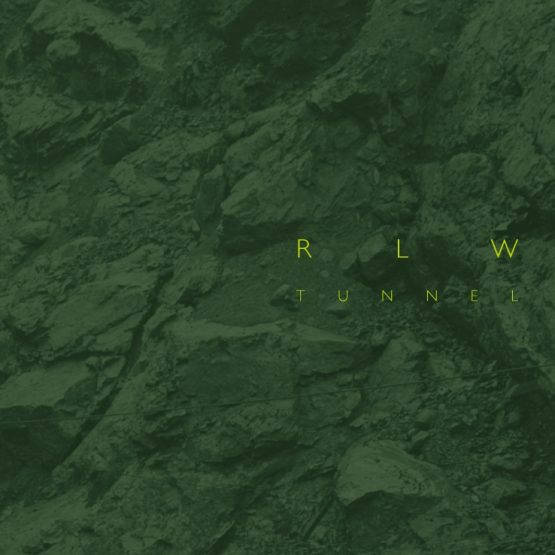
RLW – “Tunnel”
10,00 €
RLW ( aka Ralf Wehowsky ) whose work deals in the transformation of prerecorded sound material, the permutation of the senses and the metamorphosis of the sensitive, has been a proponent of long distance collaborations for decades, long before lockdown made this manner of working popular. This goes way back to his beginnings with Permutative Distortion or P16.D4 and the Selektion label. He is a strict and disciplined composer, a formal organizer of discernible objects.
Tunnel presents five pieces built using fragments of Annette Krebs's voice. Far from being anecdotal, the work reveals a true alchemy. Vocal prints are converted into roaring metallic textures lost in an endless sonic vortex, both sculptural and masterful.
Add to cart
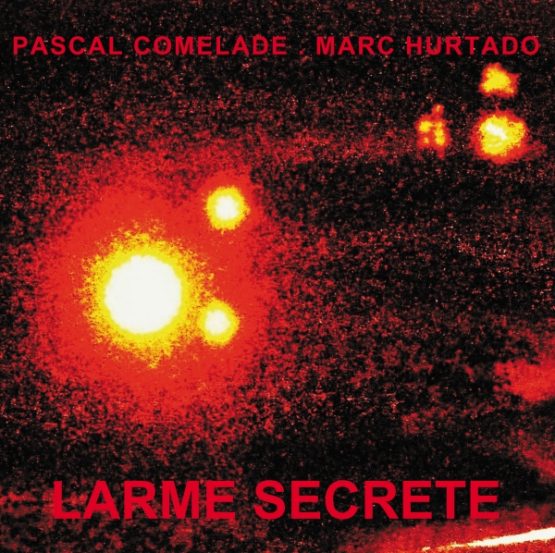
Pascal COMELADE & Marc HURTADO – “Larme secrète” 2xLP
27,00 €
2 LPS, gatefold cover, cut at 45rpm. With 3 bonus tracks exclusive for this vinyl edition.
"Larme secrète" is the result of an astonishing encounter between a minimal and discreet musician attracted as much by Erik Satie as he is by various pop classics, and a poet/performer who has worked with Lydia Lunch, Genesis P-Orridge , Michael Gira as well as Alan Vega. Pascal Comelade et Marc Hurtado (Étant Donnés) are two important figures of a french underground and alternative music scene which has always attempted to interfere with other musical genres. They are both also producers, fans and cultured listeners who meld a vast array of elements and references into a dark synthesis, a hypnotic and cosmic electroshock.
This project was born following the collaboration on stage by Pascal Comelade and Marc Hurtado during a tribute to Alan Vega that Marc Hurtado organized in Paris in 2018. Larme Secrète is the sound of an electric shock, the sound of two hearts beating at the same rhythm, united in the thrilling and hypnotic music of Pascal Comelade, melted in the fire of the celestial poems of Marc Hurtado. Synthesizers, guitars, drums, organ, piano, sound loops seem to collide high in the sky with whispered, yelled, possessed voices.
Pascal Comelade was born in Montpellier. After living in Barcelona for several years, he produced his first album, under the name of Fluence, influenced by electronic music and by the group Heldon. Since 1980, Pascal Comelade has released music under his own name. Since then, his music has become more acoustic and is often characterized by the sounds of toy instruments, used as solo instruments or as part of the sound of his group, the Bel Canto Orchestra.
Marc Hurtado is half of the French experimental duo Etant Donnés. Active since the late 1970s, the group has released several albums, also collaborating with people like Alan Vega, Lydia Lunch, Michael Gira or Genesis P-Orridge. Marc Hurtado has directed many films and has also released several solo albums under his own name.
Add to cart
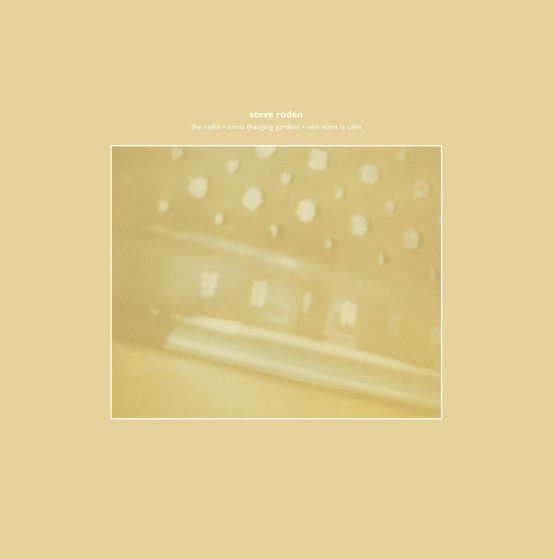
Steve RODEN – “the radio • airria (hanging garden) • vein stem is calm”
18,00 €
Sonoris is pleased to announce the release both on vinyl and cd, with a new mastering by Giuseppe Ielasi, of some important works from the influential and respected artist Steve Roden. These tracks, which mix conceptual composition and musicality, transcend the ambient or lowercase categories too quickly applied to his music, due to its ghostly beauty.
_
In the tradition of John Cage's Cartridge music amplified objects, Steve Roden extracts a fine and delicate music through his manipulation of specific objects, with an apparent simplicity that hides a captivating magic. Whilst reinventing a form of ambient music which is discreet and atmospheric, Steve Roden delivers sound textures, gives shape to color swatches, traces vibrant frequencies and creates visual art objects.
Roden, both a visual and a sound artist often tagged as minimal for want of a better description, builds the sound design of a life, a new construction for the future which encompasses architecture, visual arts, and painting in a single form.
• The radio (1996): The sound sources are derived from the object itself: the airwaves as well as the internal mechanics (aerial,springs, knobs ...). Originally released as a miniCD by Sonoris, this work centered on Roden's voice and found sound loops is now unexpectedly considered a classic and was seen as "a particularly modest form of genius" in a review by The Wire at the time.
• Airria ( hanging garden ) (2003): Arnold Schönberg's work " The book of hanging gardens " haunts the piece, and is used as a backbone over which a ghostly and exhilarating vocal hovers. Both unsettling and relaxing, this track from the "Speak no more about the leaves" CD has strangely become a mini phenomenon on youtube with its number of views and comments.
• Vein stem is calm (1996): A few seconds taken from a Ralf Wehowsky piece are shaped into a nocturnal raga imbued with substances of an indeterminate nature.
_
Steve Roden is a visual and sound artist from Los Angeles, living in Pasadena. His work includes painting, drawing, sculpture, film/video, sound installation, text and performance. In the sound works, singular source materials such as objects, architectural spaces, and field recordings, are abstracted through humble electronic processes to create new audio spaces, or possible landscapes. The sound works present themselves with an aesthetic Roden has described as lower case – sound concerned with subtlety and the quiet activity of listening.
_
Mastering by Giuseppe Ielasi.
Cut by Fred Alstadt at Studio Angström
Add to cart
Steve RODEN – “the radio • airria (hanging garden) • vein stem is calm”
10,00 €
Sonoris is pleased to announce the release both on vinyl and cd, with a new mastering by Giuseppe Ielasi, of some important works from the influential and respected artist Steve Roden. These tracks, which mix conceptual composition and musicality, transcend the ambient or lowercase categories too quickly applied to his music, due to its ghostly beauty.
_
In the tradition of John Cage's Cartridge music amplified objects, Steve Roden extracts a fine and delicate music through his manipulation of specific objects, with an apparent simplicity that hides a captivating magic. Whilst reinventing a form of ambient music which is discreet and atmospheric, Steve Roden delivers sound textures, gives shape to color swatches, traces vibrant frequencies and creates visual art objects.
Roden, both a visual and a sound artist often tagged as minimal for want of a better description, builds the sound design of a life, a new construction for the future which encompasses architecture, visual arts, and painting in a single form.
• The radio (1996): The sound sources are derived from the object itself: the airwaves as well as the internal mechanics (aerial,springs, knobs ...). Originally released as a miniCD by Sonoris, this work centered on Roden's voice and found sound loops is now unexpectedly considered a classic and was seen as "a particularly modest form of genius" in a review by The Wire at the time.
• Airria ( hanging garden ) (2003): Arnold Schönberg's work " The book of hanging gardens " haunts the piece, and is used as a backbone over which a ghostly and exhilarating vocal hovers. Both unsettling and relaxing, this track from the "Speak no more about the leaves" CD has strangely become a mini phenomenon on youtube with its number of views and comments.
• Vein stem is calm (1996): A few seconds taken from a Ralf Wehowsky piece are shaped into a nocturnal raga imbued with substances of an indeterminate nature.
_
Steve Roden is a visual and sound artist from Los Angeles, living in Pasadena. His work includes painting, drawing, sculpture, film/video, sound installation, text and performance. In the sound works, singular source materials such as objects, architectural spaces, and field recordings, are abstracted through humble electronic processes to create new audio spaces, or possible landscapes. The sound works present themselves with an aesthetic Roden has described as lower case – sound concerned with subtlety and the quiet activity of listening.
_
Mastering by Giuseppe Ielasi.
Add to cart
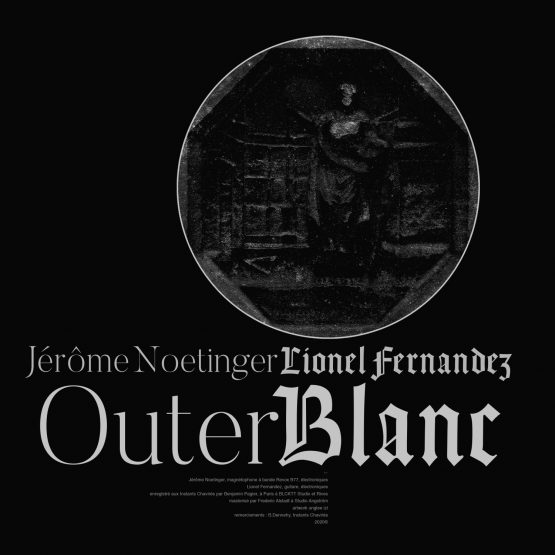
Jérôme NOETINGER & Lionel FERNANDEZ – “Outer Blanc”
18,00 €
Highly electrified guitar, anamorphosed, perforated, and tainted by all sorts of effects, implodes its rage and its urgency in the magnetic nets of a tape recorder as cannibal as it is destructive. From various recordings Lionel Fernandez & Jérôme Noetinger have created and produced these ten pieces: big, biting, dangerous and acerbic - like the intoxicated meeting of a chainsaw and a microphone. Real garage music: grease, gutted car bodies and outdated alternators, like a soundtrack ripped from an unreleased Tobe Hooper film.
Lionel Fernandez and Jérôme Noetinger: a musical encounter between two important and uncompromising figures in contemporary experimental music in France. This duo emerged during an evening of the label Premier Sang programmed at Instants Chavirés (Montreuil) in the 2010s... A few years and a few furious concerts later and it is now on the Sonoris label that they are releasing their first record.
 Guitarist of the pioneering french free noise/no wave band Sister Iodine, Lionel Fernandez uses an out of norm practice of the electric guitar in a group or as solo playing, "a guitar used as a flame thrower thrashed and fiercely held up as machette totem, he chops through darkness with unsane anti-riffs and carved blocs of dirty sounds, where gargle in slow combustion gangreened micro-textures » (Le Non_Jazz)
He also plays in other deviant combos such as Antilles, Cobra Matal, Ibiza Death, Haine, Porsche, Discom, Minitel, Mauser M etc and has collaborated either live or on records with Masaya Nakahara, Meyna’ch/Mütiilation, Andy Bolus/Evil Moisture, Stephen Bessac/Kickback, Hendrik Hegray, Tujiko Noriko etc..
Jérôme Noetinger is a composer, improviser and sound artist who works with electroacoustic devices such as the Revox B77 reel-to-reel tape recorder and magnetic tape, analogue synthesisers, mixing desks, speakers, microphones, various electronic household/everyday objects and home-made electronica.
From 1987 to 2018, he was the director of Metamkine, a non-profit organisation dedicated to the distribution of improvised and electroacoustic music. Between 1987 and 2014 Jérôme was a member of the editorial committee of the quarterly journal of contemporary sound, poetry and performance, Revue & Corrigée. For ten years from 1989, he was a member and programming co-ordinator of exhibitions, gigs, and experimental cinema at le 102 rue d'Alembert, Grenoble.
_
Lionel Fernandez, guitar, electronics
Jérôme Noetinger, Revox B77, electronics
10 tracks, 42 minutes, master by Fred Alstadt at Studio Angström
Guitarist of the pioneering french free noise/no wave band Sister Iodine, Lionel Fernandez uses an out of norm practice of the electric guitar in a group or as solo playing, "a guitar used as a flame thrower thrashed and fiercely held up as machette totem, he chops through darkness with unsane anti-riffs and carved blocs of dirty sounds, where gargle in slow combustion gangreened micro-textures » (Le Non_Jazz)
He also plays in other deviant combos such as Antilles, Cobra Matal, Ibiza Death, Haine, Porsche, Discom, Minitel, Mauser M etc and has collaborated either live or on records with Masaya Nakahara, Meyna’ch/Mütiilation, Andy Bolus/Evil Moisture, Stephen Bessac/Kickback, Hendrik Hegray, Tujiko Noriko etc..
Jérôme Noetinger is a composer, improviser and sound artist who works with electroacoustic devices such as the Revox B77 reel-to-reel tape recorder and magnetic tape, analogue synthesisers, mixing desks, speakers, microphones, various electronic household/everyday objects and home-made electronica.
From 1987 to 2018, he was the director of Metamkine, a non-profit organisation dedicated to the distribution of improvised and electroacoustic music. Between 1987 and 2014 Jérôme was a member of the editorial committee of the quarterly journal of contemporary sound, poetry and performance, Revue & Corrigée. For ten years from 1989, he was a member and programming co-ordinator of exhibitions, gigs, and experimental cinema at le 102 rue d'Alembert, Grenoble.
_
Lionel Fernandez, guitar, electronics
Jérôme Noetinger, Revox B77, electronics
10 tracks, 42 minutes, master by Fred Alstadt at Studio Angström
Add to cart
Jérôme NOETINGER & Lionel FERNANDEZ – “Outer Blanc”
10,00 €
Highly electrified guitar, anamorphosed, perforated, and tainted by all sorts of effects, implodes its rage and its urgency in the magnetic nets of a tape recorder as cannibal as it is destructive. From various recordings Lionel Fernandez & Jérôme Noetinger have created and produced these ten pieces: big, biting, dangerous and acerbic - like the intoxicated meeting of a chainsaw and a microphone. Real garage music: grease, gutted car bodies and outdated alternators, like a soundtrack ripped from an unreleased Tobe Hooper film.
Lionel Fernandez and Jérôme Noetinger: a musical encounter between two important and uncompromising figures in contemporary experimental music in France. This duo emerged during an evening of the label Premier Sang programmed at Instants Chavirés (Montreuil) in the 2010s... A few years and a few furious concerts later and it is now on the Sonoris label that they are releasing their first record.
Guitarist of the pioneering french free noise/no wave band Sister Iodine, Lionel Fernandez uses an out of norm practice of the electric guitar in a group or as solo playing, "a guitar used as a flame thrower thrashed and fiercely held up as machette totem, he chops through darkness with unsane anti-riffs and carved blocs of dirty sounds, where gargle in slow combustion gangreened micro-textures » (Le Non_Jazz)
He also plays in other deviant combos such as Antilles, Cobra Matal, Ibiza Death, Haine, Porsche, Discom, Minitel, Mauser M etc and has collaborated either live or on records with Masaya Nakahara, Meyna’ch/Mütiilation, Andy Bolus/Evil Moisture, Stephen Bessac/Kickback, Hendrik Hegray, Tujiko Noriko etc..
Jérôme Noetinger is a composer, improviser and sound artist who works with electroacoustic devices such as the Revox B77 reel-to-reel tape recorder and magnetic tape, analogue synthesisers, mixing desks, speakers, microphones, various electronic household/everyday objects and home-made electronica.
From 1987 to 2018, he was the director of Metamkine, a non-profit organisation dedicated to the distribution of improvised and electroacoustic music. Between 1987 and 2014 Jérôme was a member of the editorial committee of the quarterly journal of contemporary sound, poetry and performance, Revue & Corrigée. For ten years from 1989, he was a member and programming co-ordinator of exhibitions, gigs, and experimental cinema at le 102 rue d'Alembert, Grenoble.
_
Lionel Fernandez, guitar, electronics
Jérôme Noetinger, Revox B77, electronics
10 tracks, 42 minutes, master by Fred Alstadt at Studio Angström
Add to cart
Jim O’ROURKE – “to magnetize money and catch a roving eye”
30,00 €
A 4-hour work recorded at Steamroom (composer's studio) between 2017 and 2018.
Detailed and delicate electronic layers, processed instruments, and ambiguous field recordings come together in a slow-moving, fascinating kaleidoscope with multiple reflections and wrong turns, always in constant state of flux. The finely crafted art of subterfuge.
"To magnetize money and catch a roving eye", four CD's - a hypnotic, multi-faceted, labyrinthine piece which flows as slowly as a river while speeding back through memory, and shows all the talent of Jim O'Rourke.
Composer, performer, multi-instrumentalist, born in Chicago in 1969, Jim O' Rourke is a veritable chameleon, working at the frontiers of very diverse musical genres.
"But it’s O'Rourke's poetic, tactile grasp of aural alchemy that really sets this 4CD in realms comparable with everything from Luc Ferrari’s surreal, serendipitous narratives, to the other-dimensional magic of Roland Kayn’s cybernetics and the liminal edges of Japanese environmental music, albeit imagined for non-terrestrial climates. Whatever angle these four pieces are approached from, everyone will surely draw on one of their myriad, fluctuating elements in slow moving saccades of the ear until a bigger picture emerges, like some Google deep dream landscape or mushie-induced revelation. Essentially it’s all the work of a modern mystic or shaman, no less."
Boomkat.
"An immersive, intricate effort of rare artistry, like everything to emerge from O’Rourke’s hands, it proves, decades in, that he’s still ahead of the game. Building on decades of electronic investigation, recorded at Steamroom between 2017 and 2018, and stretching to roughly 4 hours in length, To Magnetize Money and Catch a Roving Eye is unquestionably among Jim O’Rourke’s most ambitious efforts to date. A glacially moving, immersive sonic expanse, shifting and intertwining a vast rage of sonic palettes from the realm of electro-acoustics, into a single, unified force, the album is so diverse in it materiality, that it becomes almost impossible to address beyond the realm of experiential phenomena - a universe of its own, rippling with imagistic texture and tone, bound by careful structure, to be occupied and wandered within. From long tone, droning passages to abstract collisions of texture and tone, no mater how wild O’Rourke gets, a remarkable sense of control and focused energy permiates the entirely of the work, leaving the listener on the edge of their seat, and not an idle moment within."
SoundOhm
Add to cart
Out of Print
Lionel MARCHETTI – “Jeu du monde”
40,00 €
"Jeu du monde" is a collection of around twenty musique concrète pieces which spreads over more than six hours of music.
Each CD has been designed as an audio film which tells a full story. The box set includes previously released works which have long been unavailable, reworked versions of digital releases, as well as unreleased pieces especially composed for this occasion.
With the use of a complex sound palette ( synthesizers, analog and digital manipulation, percussion, low fidelity samplers, radios, Revox, vocals, prepared piano, field recordings... ), Lionel Marchetti takes us through an audio landscape in which the acoustic imagination feeds on nature and its diversity: the desert, the upper atmosphere -mankind - night and day, fire, death, until we disappear into the ocean space...
Lionel Marchetti is a French composer of musique concrète and an improviser (various analog and digital electronic instruments and modified speakers ). He also writes poetry and essays on the art of Musique Concrète, as an artist working within the genre.
His musique concrète works follow in the steps of composers such as Pierre Henry, Bernard Parmegiani and Michel Chion.
Read more